Butter measure conversion

Butter Stick Conversion Calculator

Convert US butter sticks to cups, spoons, weight, pounds, and approximate milliliters.

Butter amount

Enter US butter sticks

Butter
sticks
Measurement summary

Equivalent butter measures

The equivalent measures will appear here

One US stick is treated as 113.4 grams and one-half cup.

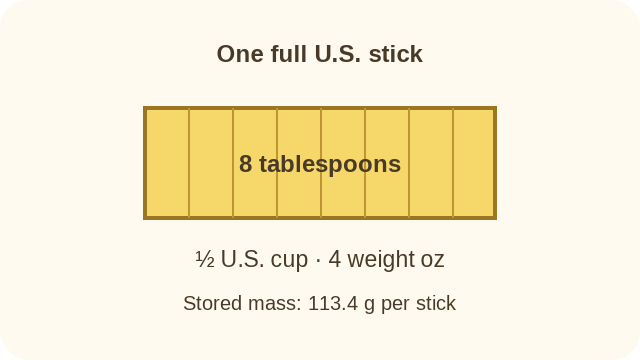
One US butter stick shown with cup spoon and gram equivalents
The conversions use the common US stick definition; package sizes differ between countries.

How Much Is a Full U.S. Stick of Butter?

Convert U.S. butter sticks to cups, spoons, grams, ounces, pounds and approximate milliliters. This calculator accepts a nonnegative stick count, including decimals, and applies seven stored factors. One full stick represents half a U.S. cup, eight tablespoons and four weight ounces.

A stick is a package convention, not a universal butter size. The code uses 113.4 g per full stick and a rounded volume factor of 118.29 mL. Check whether your package is a full U.S. stick, a half stick or a block before entering its count.

How to Use the Butter Stick Calculator

  1. Identify how much butter you have in full U.S. stick equivalents. A labeled half stick counts as 0.5, not one full stick.
  2. Enter that nonnegative amount in US butter sticks. Decimal stick counts are accepted; the visible two-stick example is a placeholder.
  3. Select Convert butter. The form multiplies the count independently by each stored factor.
  4. Read Equivalent cups at the top, then tablespoons, teaspoons, grams, weight ounces, pounds and approximate volume below. These describe the same butter amount.
  5. Use the unit and product assumption matching the recipe. For an unfamiliar block size, weigh the amount and verify the package rather than assuming one block is one stick.

Negative counts, blanks and nonnumeric entries are rejected. There is no switch for another country’s package size, salted/unsalted composition, melted butter or reverse conversion from grams. The form does not round to whole packages for shopping.

Butter Stick Conversion Formulas

cups = full U.S. sticks × 0.5

tablespoons = sticks × 8; teaspoons = sticks × 24

grams = sticks × 113.4; weight ounces = sticks × 4

pounds = sticks × 0.25

approximate milliliters = sticks × 118.29

Land O’Lakes documents the full-stick cup and spoon convention. Its table rounds the gram amount to 113 for one stick, whereas this application retains 113.4. The NIST reference supports customary mass and volume relationships, but weight ounces and fluid ounces remain different quantities.

The code calculates every output directly from the original stick count. It rounds pounds to three decimals and the other values to two. A small amount may display zero cups while a spoon or gram result remains positive. Approximate mL is a volume equivalent under the stored cup convention, not grams treated as water.

Butter Sticks and Equivalent Measures

US butter sticks
Nonnegative number of full-stick equivalents. A fractional package can be entered as a decimal.
Equivalent cups
Main U.S. cup amount from sticks × 0.5, rounded to two decimals.
Tablespoons
Same butter quantity in U.S. kitchen tablespoons, using eight per full stick.
Teaspoons
Same quantity using 24 teaspoons per stick, or three per tablespoon.
Grams
Mass using the stored 113.4 g/stick factor, rounded to two decimals.
Ounces
Weight ounces, using four per stick. These are not fluid ounces.
Pounds
Mass using one-quarter pound per full stick, rounded to three decimals.
Approximate volume
Milliliters from sticks × 118.29. It is not an independent measurement of melted product density.

The stick diagram is static and labels the package convention. It does not show the shape of a particular brand or indicate that every block has the same mass.

Butter Stick Conversion Example

Illustrative example. Enter 1.375 full U.S. sticks, equivalent to 1⅜ sticks. Cup volume is 1.375 × 0.5 = 0.6875 cups, displayed as 0.69 cups.

The other mass and spoon conversions are 11 tbsp, 33 tsp, 155.925 g, 5.5 oz and 0.34375 lb before final rounding where needed. The page displays 155.93 g and 0.344 lb. Approximate volume is 1.375 × 118.29 = 162.64875 mL, displayed as 162.65 ml.

Calculation check. Independent multiplication reproduces each endpoint output. The rounded 0.69 cup display times 16 would give 11.04 tablespoons, whereas the direct original-stick calculation correctly gives 11. Keep the original input for precision checks.

Illustrative 1.375 full U.S. butter sticks
MeasureBefore roundingDisplayed result
Cups0.68750.69 cups
Mass155.925 g155.93 g
Pounds0.34375 lb0.344 lb
Approximate volume162.64875 mL162.65 ml

Why Butter Conversion Results Round Differently

Direct conversion from the original stick count avoids a chain of rounded intermediate values. The original 1.375-stick example makes this visible.

Independent result rounding rather than a chained conversion
Calculation pathBefore final roundingResult
Direct spoons1.375 × 811 tbsp
From displayed cups0.69 × 1611.04 tbsp
Direct mass1.375 × 113.4155.93 g after rounding

The original cup amount is 0.6875, and 0.6875 × 16 gives exactly 11 tablespoons. The difference appears only after the cup display rounds to 0.69. The controller correctly uses the original stick count for each answer rather than multiplying that rounded cup card.

The stored gram and mL constants are rounded too. Use the unit the recipe specifies and keep the original entry if checking another result. An approximate mL equivalent does not claim that butter has the same density as water or that its volume is temperature-independent.

Understanding Butter Weight and Volume

The outputs are equivalent descriptions, not separate ingredients to add together. Reading 0.69 cups and 155.93 g does not mean the recipe needs both quantities. Choose the measurement your recipe uses.

Mass and volume need different handling. Butter grams do not equal butter milliliters, and the weight-ounce answer is not a liquid measure. The mL output follows a rounded U.S.-cup volume factor rather than measuring a product at a chosen temperature.

The full-stick convention makes fractional inputs useful. Half a full stick is 0.5 input, while two manufacturer half sticks total one. Package labels and markings can help confirm the count, but the form does not recognize product names or scan packaging.

Rounding affects small amounts and chained checks. Every result is calculated from sticks independently, so converting a rounded card into another unit may disagree slightly. The tool does not convert a total butter mass into its fat, water or salt components and is not a butter-making yield calculator.

Common Butter Measurement Mistakes

  • Treating a 250 g block or a half-stick package as one full U.S. stick.
  • Entering grams into the stick-count field.
  • Adding equivalent cups and grams as though they were separate amounts.
  • Reading weight ounces as fluid ounces.
  • Treating butter mL as numerically equal to grams.
  • Using a rounded cup result to recreate every other card exactly.

Butter Conversion FAQs

How much is one full U.S. stick of butter?

This tool uses 0.5 cup, eight tablespoons, 24 teaspoons, 113.4 g, four weight ounces, 0.25 lb and approximately 118.29 mL.

Can I enter a fraction of a stick?

Yes. Enter its decimal value, such as 0.5 for half a full stick or 1.375 for one and three-eighths sticks. The form accepts nonnegative decimals.

Is a half-stick package one stick in the input?

No. A manufacturer half stick is 0.5 of the full-stick convention used here. Two half sticks together count as one full stick.

Why does another chart say 113 grams instead of 113.4?

Kitchen charts round the same package convention differently. This application uses its stored 113.4 g factor and rounds the final result to two decimals.

Are the ounces fluid ounces?

No. The ounce result is mass. The separate cup and approximate milliliter outputs describe volume.

Why does a rounded cup result not reproduce the spoon answer exactly?

Each answer comes directly from the original stick count. Rounding a cup display before converting again can introduce a difference.

Can I convert an arbitrary butter block or grams back to sticks?

The visible form accepts full-stick count only. Verify the actual package mass and convention separately; it has no block-size or reverse-input setting.

Does this calculate melted butter composition or homemade butter yield?

No. It converts one stated package amount into equivalent measures. It does not model fat content, temperature, cream churning or final product yield.

Sources and References