Mathematics calculator

Division Calculator

Divide one real number by another and review the quotient, expression, and multiplication check.

Calculator inputs

Enter your values

Real-number division
Calculated output

Result summary

Your result will appear here

Complete the required fields and select the calculate button.

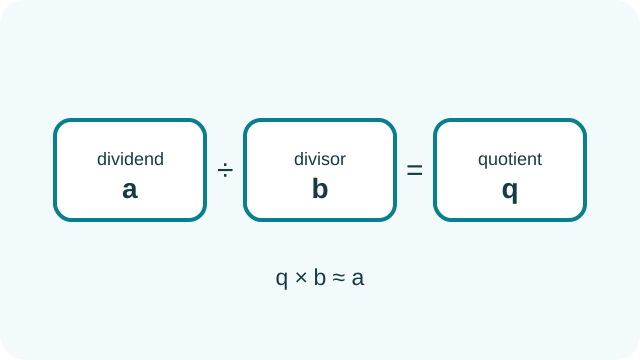
A division relationship connecting dividend, divisor, and quotient
Multiplying the quotient by the divisor should reconstruct the dividend, apart from display rounding.
1

What is Division Calculator?

The division calculator evaluates one number divided by another and reports the decimal quotient. Division answers questions such as “how much is in each equal group?” and “how many times does this amount fit into that one?” Enter the total or dividend first and the divisor second.

The two positions are not interchangeable. Although 12 ÷ 3 equals 4, reversing them gives 3 ÷ 12 = 0.25. The form accepts positive values, negative values and decimals, while rejecting a divisor of zero because division by zero has no defined real-number result.

2

How to Use This Calculator

  1. Enter the dividend in box A. This is the amount being divided.
  2. Enter the divisor in box B. This is the size or number of groups and must not be zero.
  3. Select Calculate to evaluate A ÷ B. The quotient is rounded to four decimal places when necessary.
  4. Check the answer by multiplying the displayed quotient by B. Allow for a small difference if the quotient was rounded.

Think about the labels before entering a practical problem. If 18 litres fill 6 containers equally, 18 is the dividend and 6 is the divisor, producing 3 litres per container. If the question asks how many 6-litre containers can be filled from 18 litres, the same operation happens to have the same numerical setup.

3

Formula Used

Quotient = dividend ÷ divisor = A / B, where B ≠ 0

The relationship can be checked as dividend = divisor × quotient. For whole-number division, a remainder may also be written: dividend = divisor × whole-number quotient + remainder. This page reports the decimal quotient rather than a separate remainder.

4

Variables Explained

TermMeaning
Dividend (A)The number or quantity being divided.
Divisor (B)The nonzero number by which A is divided.
QuotientThe result of A ÷ B.
RemainderThe amount left after whole-number grouping; it is represented by the decimal part here.
SignA negative dividend or divisor changes the sign of the quotient; two negative signs give a positive result.
5

Worked Example

For 17 ÷ 4, enter 17 as A and 4 as B. The quotient is 4.25. In equal-group language, four groups of 4 use 16 and the remaining 1 is one quarter of the divisor, so 4 + 1/4 = 4.25. Multiplying 4.25 × 4 returns 17.

For a signed example, −15 ÷ 6 = −2.5. Only one input is negative, so the quotient is negative. If both were negative, −15 ÷ −6 would be 2.5. For a small quotient, 1 ÷ 8 = 0.125; a result below 1 simply means the dividend is smaller in magnitude than the divisor.

6

Why Use This Calculator?

The quotient takes its meaning from the inputs. Dividing a currency total by a number of people gives currency per person. Dividing kilometres by hours gives kilometres per hour. Dividing two amounts with the same unit produces a unitless ratio. Write the unit beside the answer instead of treating every quotient as a bare number.

The displayed value is rounded to four decimal places. Repeating decimals such as 2 ÷ 3 appear as 0.6667, which is an approximation. Do not multiply a rounded display through many later steps when higher precision matters; retain the original fraction or calculate with additional digits.

A negative answer is mathematically valid when exactly one input is negative, but its practical meaning depends on context. Negative quantities may represent debt, direction or change. A negative headcount or container count would usually signal that the inputs do not match the real situation.

7

Common Mistakes

  • Entering the divisor first reverses the operation and usually changes the answer.
  • Zero cannot be used as B. Even 0 ÷ 0 is indeterminate rather than zero.
  • A decimal quotient is not the same presentation as a quotient with remainder. For 17 ÷ 4, 4.25 corresponds to 4 remainder 1.
  • Do not drop units. Dividing 120 miles by 3 hours produces 40 miles per hour.
  • Round at the end, especially when the result feeds another calculation.
8

Frequently Asked Questions

Why can I not divide by zero?

There is no number that can be multiplied by zero to recover a nonzero dividend. Allowing a zero divisor would break the inverse relationship between multiplication and division.

What happens when the dividend is zero?

Zero divided by any nonzero number is zero. The total amount is zero, so every equal share is also zero.

How are negative signs handled?

One negative input gives a negative quotient. Two negative inputs give a positive quotient, following the ordinary sign rules for multiplication and division.

Does the result include a remainder?

The page gives a decimal quotient. A whole-number quotient and remainder is another way to express some divisions, such as 17 ÷ 4 = 4 remainder 1.

Why is my repeating decimal rounded?

Some fractions have decimal expansions that never terminate. The display rounds to four places, so 2 ÷ 3 appears as 0.6667.

How can I check a quotient?

Multiply the quotient by the divisor. It should reproduce the dividend, apart from a small difference caused by rounding the displayed quotient.

9

Sources & References