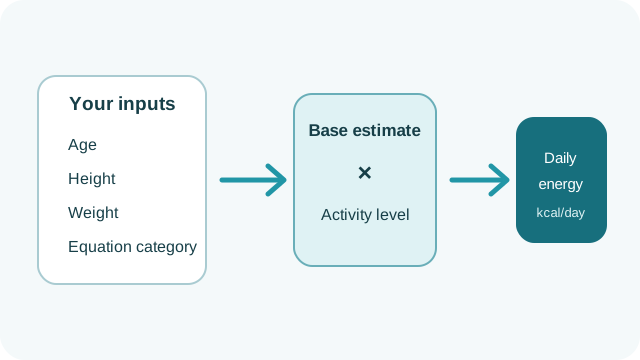
Estimate daily energy requirement for adults using age, sex-specific equation category, body measurements, and activity level.
Personal inputs
Enter adult measurements and activity
EER
Energy summary
Estimated daily requirement
The energy estimate will appear here
Choose the activity category that most closely matches a typical week.
Estimated energy requirementAdult EER equation with sex-specific activity coefficient
Estimated energy
0 kcal/day
Activity category
—
Equation category
—
Educational estimate only. It is not medical advice, a diagnosis, or a substitute for assessment by a qualified healthcare professional. This population equation is not an individual nutrition prescription and does not cover pregnancy or breastfeeding.
The equation combines age, converted height and weight, and a broad physical-activity coefficient.
Estimated Energy Requirement (EER) is a model-based estimate of average dietary energy intake expected to maintain energy balance for a healthy person with the entered age, body size, sex equation and physical-activity category. This page applies the adult equations published with the Dietary Reference Intakes.
The number is a population reference, not a prescribed calorie target and not a diagnosis. Individual energy use varies, and the equations do not capture every factor that can affect needs. The page is limited to adults aged 19 or older and does not provide the separate equations used for children, pregnancy or lactation.
2
How to Use This Calculator
Select the male or female adult equation. These are the two biological-sex equation categories in the source model.
Enter completed age from 19 through 120 years.
Enter measured height and choose centimetres, metres, inches or feet. The value is converted to metres.
Enter measured weight and choose kilograms or pounds. Pounds are converted to kilograms.
Select sedentary, low active, active or very active. Each category maps to a sex-specific physical-activity coefficient from the adult equations.
Calculate and read the estimate in kilocalories per day. Review the model scope and avoid treating the rounded value as an exact daily requirement.
Activity categories have formal descriptions related to daily living plus additional physical activity. A wearable’s label or another nutrition calculator’s multiplier may not match these coefficients. Choose the closest category cautiously and consider more than one scenario when activity is near a boundary.
3
Formula Used
For the adult male equation used here: EER = 662 − 9.53 × age + PA × (15.91 × weight + 539.6 × height).
For the adult female equation: EER = 354 − 6.91 × age + PA × (9.36 × weight + 726 × height).
Weight is kilograms, height is metres, age is years and the result is kilocalories per day. Male PA values are 1.00, 1.11, 1.25 and 1.48; female PA values are 1.00, 1.12, 1.27 and 1.45 for sedentary through very active. These coefficients belong to these particular equations and should not be replaced with multipliers from a different method.
4
Variables Explained
Entry
How the adult EER model uses it
Sex equation
Selects the published adult male or female constants and physical-activity coefficients.
Age
Completed years; this page accepts adults from 19 through 120.
Height
Measured stature, converted to metres before applying the equation.
Weight
Measured body mass, converted to kilograms.
PA
Sex-specific coefficient associated with sedentary, low active, active or very active.
EER
Estimated energy requirement in kilocalories per day under the model’s maintenance context.
5
Worked Example
Consider a 30-year-old using the male equation, weighing 70 kg, measuring 1.75 m and selecting sedentary, for which PA = 1.00:
The same physical measurements with the male active coefficient of 1.25 would give about 2,948.60 kcal/day. That difference is the model’s activity adjustment; it is not a promise that every person who selects active expends exactly that amount. If weight were entered as 154.32 pounds and height as 68.90 inches, the unit conversions would be approximately 70 kg and 1.75 m and should lead to nearly the same result.
6
Why Use This Calculator?
EER is intended as an average energy-balance estimate. Daily intake and expenditure naturally vary, so matching the number on every single day is unnecessary. Changes in body weight and other observations over time may provide context, but they can also reflect fluid shifts, illness, medication or measurement error.
The equation’s categories do not cover growth in children, pregnancy, lactation or a therapeutic nutrition plan. Athletes, people with medical conditions, people recovering from illness, and those seeking intentional weight change may need an individualized assessment. A registered dietitian or other qualified clinician can consider health history, goals and observed trends.
Do not infer food quality from calories alone. Nutrient adequacy, dietary pattern, access, preferences and clinical needs still matter. Seek professional advice for unexplained weight change, disordered-eating concerns or a condition that affects nutrition. Urgent symptoms require appropriate medical care rather than a calculator.
7
Common Mistakes
Using the page for a child: the displayed equations and validation are for ages 19 and older.
Choosing activity by job title alone: consider the source model’s overall daily activity concept.
Mixing units: select the actual height and weight units; do not enter pounds while leaving kilograms selected.
Using pregnancy or lactation without adjustment: those stages have separate energy considerations not calculated here.
Treating the result as exact: it is an estimate with individual variation.
Confusing kcal with small calories: food labels commonly use “Calories” to mean kilocalories.
8
Frequently Asked Questions
Is EER the same as basal metabolic rate?
No. EER estimates total daily energy needed for balance under the selected activity category. Basal metabolic rate concerns energy use under resting laboratory conditions.
Can this calculator be used for children?
No. This page uses adult equations and accepts ages 19 and older. Children and adolescents have separate equations that account for growth.
Does the estimate apply during pregnancy or lactation?
No. Those stages involve additional model components and individual considerations that this form does not request.
Why can another calorie calculator give a different result?
It may use a different equation, activity definition, age range or objective. Compare methods and units before treating the difference as an error.
What does sedentary mean in this calculation?
It selects PA = 1.00 in the adult equations. It should be understood in the context of the source model rather than as a judgment about health.
Should I change my diet to match the exact result?
The result is a planning reference, not a prescription. Health conditions, observed trends and personal goals may call for advice from a qualified dietitian or clinician.