A result greater than one means the operation increased a positive base relative to 1 in this case; a value between zero and one can arise from a negative exponent or from taking a positive power of a base between zero and one. The behavior depends jointly on base and exponent, so avoid reading the result from the exponent sign alone.
Displayed decimals may be approximations of irrational values. For example, 21/2 is exactly √2, but its decimal expansion never terminates. Keep the radical or exponent form when exact algebra matters and use the decimal for measurement or numerical comparison.
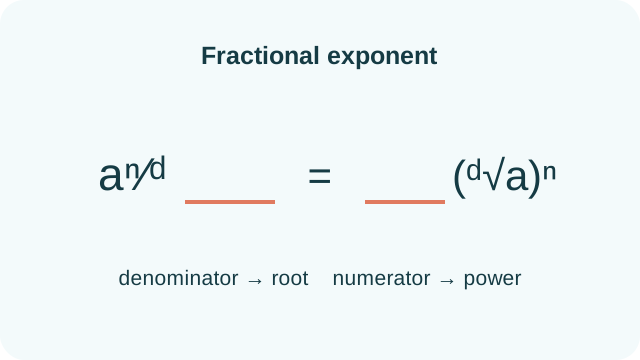
Fractional powers connect exponent laws with radical notation. Adding exponents still corresponds to multiplying like bases: x1/2 × x1/2 = x for nonnegative x. Multiplying exponents corresponds to repeated powering: (x1/3)³ = x. These identities are useful checks, but real-domain restrictions must be respected when extending them to negative bases.
Units also deserve attention. Taking a square root changes dimensional meaning: the square root of 25 m² is 5 m, while raising a length to the 3/2 power yields an unusual compound dimension. In applied work, make sure the exponent is meaningful for the model instead of treating every numerical result as physically interpretable.