Mathematics calculator

Half Angle Calculator

Halve an angle in degrees and calculate sine, cosine, and tangent with the correct quadrant signs.

Calculator inputs

Enter your values

Trigonometry
Calculated output

Result summary

Your result will appear here

Complete the required fields and select the calculate button.

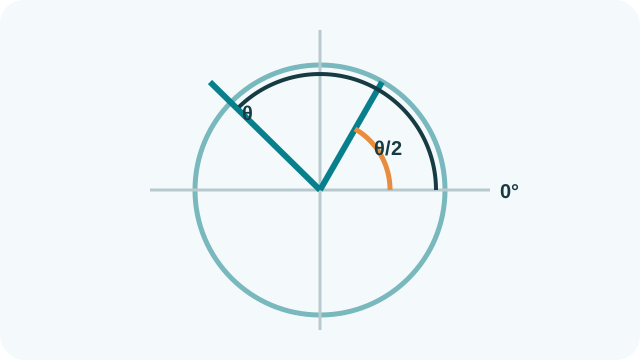
An original angle and its half shown on a unit circle with quadrant signs
Evaluating the actual half-angle preserves the correct sign in every quadrant.

What is Half Angle?

A half-angle calculation finds sine, cosine and tangent for half of a known angle. Entering 60°, for example, asks for the trigonometric values at 30°. The page also displays the half-angle itself.

The calculator evaluates the signed trigonometric functions at θ/2, so negative results are retained in quadrants where they belong. Tangent is reported as undefined when the half-angle has cosine zero.

How to Use This Calculator

  1. Enter the original angle θ in degrees, before halving it.
  2. Choose Calculate. The three results correspond to sin(θ/2), cos(θ/2) and tan(θ/2).
  3. Work out θ/2 yourself and check which quadrant contains it.
  4. Keep any exact radical form in written work if the question asks for an exact answer. The displayed values are rounded to four decimal places.

The labels Sin/2, Cos/2 and Tan/2 on the result panel refer to functions of the half-angle. They do not mean that an ordinary sine, cosine or tangent value has been divided by two.

Formula Used

sin(θ/2) = ±√((1 − cos θ)/2); cos(θ/2) = ±√((1 + cos θ)/2); tan(θ/2) = sin(θ/2) ÷ cos(θ/2). The square-root signs depend on the quadrant of θ/2; this calculator determines them by evaluating the actual half-angle.

Variables Explained

QuantityMeaning
θThe original angle in degrees, not the half-angle.
θ/2The angle whose trigonometric values are calculated.
Sine, cosine and tangentDimensionless signed ratios determined by the quadrant of θ/2. Tangent is undefined when cosine is zero.

Worked Example

Enter θ = 120°. The angle you are investigating is 60°, and cos(120°) = −0.5. The sine calculation becomes √((1 − (−0.5))/2) = √0.75 ≈ 0.8660. Cosine becomes √((1 + (−0.5))/2) = √0.25 = 0.5000.

Tangent is √((1 − (−0.5))/(1 + (−0.5))) = √3 ≈ 1.7321. All three signs are positive because 60° lies in the first quadrant. As a check, sine divided by cosine is approximately 1.7321.

Finding a less familiar angle

To investigate 15°, start with θ = 30°. Using cos(30°) = √3/2, the sine identity becomes √((1 − √3/2)/2), which is equivalent to (√6 − √2)/4. Its decimal value is about 0.2588. Cosine similarly becomes (√6 + √2)/4, or about 0.9659. These exact forms show why an angle that is not in the usual short table can still have an exact trigonometric expression.

When checking this example, do not replace √3/2 with 0.87 before substituting. That rounding changes the quantity inside a square root and can noticeably affect the final digits. Substitute exact values first, simplify where possible, then compare the rounded decimal with the page.
Why Use This Calculator?

Half-angle identities are useful when you know the cosine of an angle but need trigonometric values for an angle half as large. They also help turn angles such as 15° and 22.5° into exact expressions involving familiar angles.

If you enter 300°, the half-angle is 150°, so cosine and tangent are negative. If the half-angle is 90° plus a multiple of 180°, the page marks tangent undefined instead of displaying a misleading finite number.

Common Mistakes

  • Do not enter the half-angle when the form asks for the original angle. To investigate 30°, enter 60°.
  • Use degrees rather than radians in this form.
  • When applying radical identities by hand, choose signs from the quadrant of the half-angle.
  • Do not replace an undefined tangent with zero or a very large rounded number.

Frequently Asked Questions

Why is sin(θ/2) different from sin(θ)/2?

The first halves the angle before applying sine. The second halves the sine value afterwards. With θ = 60°, these are 0.5 and about 0.4330, respectively.

Why might another calculator show a negative answer?

Check that both calculators use degrees and the same original angle. This page evaluates the signed function at θ/2, so its sign follows the half-angle’s quadrant.

Can I use the displayed decimals as exact answers?

No. Four-place decimals are rounded approximations. For an exact exercise, retain a radical such as √3/2 and round only when the question requests a decimal.

Does halving an angle change its unit?

No. Half of 120° is 60°, still in degrees. If the original angle were expressed in radians, the half-angle would remain in radians, but this particular form expects degrees. Convert radians to degrees before using it.

Can I check the sine and cosine outputs together?

For a valid real half-angle, sin²(θ/2) + cos²(θ/2) = 1. Squaring the displayed results and adding them should give approximately one. This checks magnitudes but cannot confirm quadrant signs, because squaring removes a minus sign. Use both the identity and a separate quadrant check when evaluating angles outside the first quadrant.

Sources & References