Mathematics calculator

Hyperbolic Functions Calculator

Evaluate the six standard hyperbolic functions for a dimensionless real argument.

Calculator inputs

Enter your values

sinh, cosh, tanh
Calculated output

Result summary

Your result will appear here

Complete the required fields and select the calculate button.

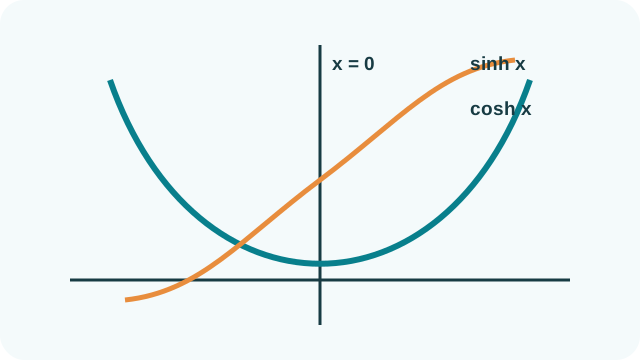
Catenary-style hyperbolic cosine curve with related hyperbolic function labels
Hyperbolic functions are built from exponentials and are different from circular sine and cosine.

What is Hyperbolic Functions?

The Hyperbolic Functions Calculator helps you evaluate the six standard hyperbolic functions for a real input. Hyperbolic sine and cosine are built from exponential functions. They appear in catenary curves, differential equations, relativity and other models that resemble trigonometry but use a hyperbola rather than a circle.

Use it as a transparent arithmetic check. The worked example below follows the same inputs and rounding as the live form, while the notes explain what the result can and cannot support.

How to Use This Calculator

  1. Enter a real number x. The page accepts values from −700 to 700 to avoid exponential overflow.
  2. Calculate sinh, cosh, tanh, coth, sech and csch.
  3. At x = 0, coth and csch are undefined and are shown without a numeric value. Retain more precision elsewhere if a later calculation is sensitive to rounding.

Write down the source and date of a real real argument before entering it. That small habit makes the result reproducible and helps another reader spot a unit or timing mismatch.

Formula Used

sinh x = (eˣ−e−x)/2; cosh x = (eˣ+e−x)/2; tanh x = sinh x/cosh x. The reciprocal functions are coth x = cosh x/sinh x, sech x = 1/cosh x and csch x = 1/sinh x.

Variables Explained

Input or resultMeaning
xDimensionless real argument.
sinh, coshPrimary hyperbolic sine and cosine values.
tanhRatio sinh/cosh, between −1 and 1 for finite real x.
coth, cschFunctions undefined at x=0 because sinh 0 = 0.
sechReciprocal of cosh; positive for real x.

Worked Example

At x = 1, sinh(1) = 1.1752, cosh(1) = 1.5431 and tanh(1) = 0.7616.

The reciprocals give coth(1) = 1.3130, sech(1) = 0.6481 and csch(1) = 0.8509 after four-decimal rounding.

Why Use This Calculator?

The identity cosh²x − sinh²x = 1 is a useful check. Signs also help: cosh and sech are even and positive, while sinh, tanh, coth and csch are odd where defined. Values near zero can make reciprocal functions very large, so a rounded display may be unsuitable for numerical work close to the singularity.

Practical use: People usually open this page when they need to evaluate the six standard hyperbolic functions for a real input without building a spreadsheet for a single question. Hyperbolic sine and cosine are built from exponential functions. They appear in catenary curves, differential equations, relativity and other models that resemble trigonometry but use a hyperbola rather than a circle. For a real decision, calculate a central case and then change the most uncertain input to a reasonable lower and upper value. Seeing that range is often more informative than treating one rounded answer as permanent.

A useful result should be repeatable: keep the original inputs, unit choices and relevant date beside the six hyperbolic function values. If a second source uses another convention, reconcile that difference before comparing the numbers.

When sharing the answer, include a short label such as “six hyperbolic function values from the stated inputs.” That label keeps the number attached to its meaning. It also prevents a reader from mistaking a converted value, model output or planning estimate for a direct observation.

Scope: It evaluates real inputs only and rounds displayed results to four decimals.
Common Mistakes

  • Confusing hyperbolic functions with ordinary sin and cos measured in radians.
  • Trying to use degrees; x is a dimensionless real argument.
  • Expecting coth(0) or csch(0) to be zero.
  • Copying a four-decimal result into a precision-sensitive calculation.

Do a quick reasonableness check after calculating. A correct-looking decimal can still answer the wrong question when the source real argument uses a different definition.

Frequently Asked Questions

What does the Hyperbolic Functions Calculator calculate?

It is designed to evaluate the six standard hyperbolic functions for a real input. The output is a six hyperbolic function values based only on the values and conventions described on this page.

Which inputs should I check before using this Hyperbolic Functions Calculator?

Check the unit, time period, sign and source definition for every entry. For this page in particular, confirm the meaning of the real argument rather than copying an unlabeled number from another source.

Why might my result differ from another calculator?

Another tool may use different rounding, units, timing or assumptions. Compare its stated formula with this page’s formula and scope. For Hyperbolic Functions Calculator, even a valid alternative convention can produce a different result without either arithmetic operation being mistyped.

How many decimal places should I keep?

Keep the displayed precision for an ordinary check, but retain source precision when the result feeds another calculation. Do not imply more measurement certainty than the original real argument provides.

Can I use the result as an official decision?

The result is an educational estimate. It evaluates real inputs only and rounds displayed results to four decimals. Use the governing document, qualified professional or official service when a decision has financial, medical, legal or safety consequences.

What is a good way to verify the worked example?

Repeat each substitution in the displayed formula, keep units beside the numbers, and reverse the operation where possible. The example is also checked against the working calculator shown on the Hyperbolic Functions Calculator.

Does changing the unit change the underlying quantity?

A legitimate unit conversion changes the numeral while preserving the quantity. A selector that merely labels currency or a model convention does not fetch outside data; the instructions above identify which behavior applies to this Hyperbolic Functions Calculator.

Sources & References