Lipid calculation

LDL Calculator — Friedewald Estimate

Estimate LDL cholesterol from total cholesterol, HDL cholesterol, and triglycerides in mg/dL.

Lipid panel

Enter fasting laboratory values

LDL
Lipid summary

Calculated LDL estimate

The LDL estimate will appear here

Use values in mg/dL from the same lipid panel.

Total cholesterol separated into HDL, triglyceride contribution, and estimated LDL
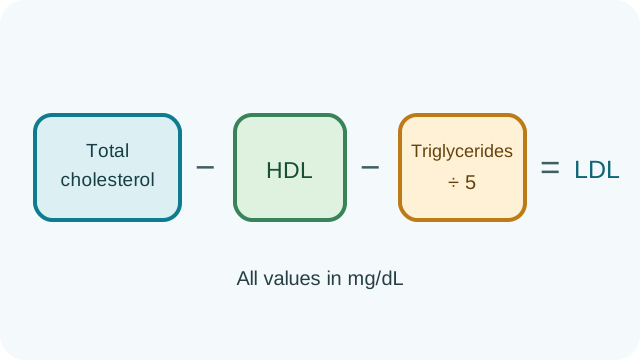
The Friedewald equation subtracts HDL and one-fifth of triglycerides from total cholesterol.

What is LDL Calculator?

The LDL calculator estimates low-density lipoprotein cholesterol with the Friedewald equation from total cholesterol, HDL cholesterol and triglycerides. All three laboratory values must be entered in mg/dL. The result is calculated LDL-C, not a direct laboratory measurement.

This equation uses triglycerides divided by five as an estimate of very-low-density lipoprotein cholesterol. That shortcut has known limits. The page rejects triglycerides at or above 400 mg/dL and combinations that would produce a negative LDL estimate, but clinical suitability still depends on the person and sample.

How to Use This Calculator

  1. Copy total cholesterol, HDL-C and triglycerides from the same lipid panel. Confirm that every value is in mg/dL.
  2. Enter the three numbers exactly as reported. Do not mix an mmol/L result into the form.
  3. Select Calculate. The result is shown in mg/dL and should be compared with the laboratory report and a clinician’s interpretation.

If the report already provides a direct or calculated LDL result, use its stated method. This page is most useful for checking the arithmetic, not replacing a laboratory.

Formula Used

LDL-C = total cholesterol − HDL-C − (triglycerides ÷ 5)

This form of the Friedewald equation applies when all concentrations are in mg/dL. The corresponding mmol/L form uses a different triglyceride divisor, so mmol/L values cannot be pasted into this page unchanged.

The fixed TG-to-VLDL relationship becomes unreliable with high triglycerides and can be less accurate at low LDL-C. Newer equations or direct measurement may be preferred in some settings.

Variables Explained

TermMeaning on this page
total cholesterolLaboratory total cholesterol concentration in mg/dL.
HDL-CHigh-density lipoprotein cholesterol in mg/dL.
triglyceridesLaboratory triglyceride concentration in mg/dL; must be below 400 here.
TG ÷ 5Friedewald estimate of VLDL cholesterol for mg/dL inputs.
LDL-CCalculated low-density lipoprotein cholesterol in mg/dL.

Worked Example

For total cholesterol of 200 mg/dL, HDL-C of 50 mg/dL and triglycerides of 100 mg/dL:

LDL-C = 200 − 50 − (100 ÷ 5)
LDL-C = 200 − 50 − 20 = 130 mg/dL

The arithmetic gives 130 mg/dL. Its clinical meaning depends on overall cardiovascular risk, treatment history and the method used by the laboratory.

Why Use This Calculator?

LDL-C is one part of a lipid assessment. A number should be interpreted with age, health history, blood pressure, smoking, diabetes and other risk information rather than treated as a diagnosis by itself. Treatment targets are individual clinical decisions.

A calculated result can differ from the report because the laboratory may use a direct assay or a newer equation. Differences also arise from rounding and from the triglyceride-to-VLDL assumption. Do not change medication or diet solely from this page.

Seek the laboratory’s advice if units are unclear or the values appear inconsistent. Triglycerides of 400 mg/dL or more fall outside this page’s accepted Friedewald range; a healthcare professional can determine a suitable alternative.

Unit cross-check: a report may show mmol/L rather than mg/dL. The three lipid substances do not all share one universal mass-to-molar factor, so changing only the label is unsafe. Use the laboratory’s units or a trusted lipid-specific conversion before applying the matching equation. The familiar triglycerides divisor of five belongs specifically to the mg/dL form used here.

Rounding can explain a small mismatch. A laboratory may retain more decimal precision for total cholesterol, HDL-C and triglycerides than appears on the printed report. Recalculating from rounded displayed components can therefore differ by a small amount. A large difference deserves a check of units, sample date and reported method rather than repeated rounding until the numbers agree.
Common Mistakes

  • Entering mmol/L numbers into fields labeled mg/dL.
  • Using values taken from different dates or different samples.
  • Applying the equation when triglycerides are 400 mg/dL or higher.
  • Assuming calculated LDL-C and directly measured LDL-C must match exactly.
  • Making a treatment decision without considering the full cardiovascular picture.

Frequently Asked Questions

Is this LDL result directly measured?

No. It is an estimate calculated from total cholesterol, HDL-C and triglycerides with the Friedewald equation.

Why must triglycerides be below 400 mg/dL?

The triglycerides-divided-by-five assumption is not considered reliable at higher levels. The page stops rather than presenting an unsuitable Friedewald estimate.

Can I enter mmol/L values?

No. This form uses the mg/dL equation. Converting lipid values requires substance-specific factors; use a validated conversion or the equation intended for mmol/L.

Why does my laboratory LDL value differ?

The laboratory may use a direct assay, another equation, unrounded source values or a different sample. Check the method printed on the report.

Does a calculated LDL number diagnose heart disease?

No. LDL-C contributes to risk assessment, but diagnosis and treatment depend on broader clinical information and professional judgment.

Do the three values need to come from one test?

Yes. Use total cholesterol, HDL-C and triglycerides from the same lipid panel so the equation describes one sample.

What should I do with an unexpected result?

Check the entries and units, then discuss the original laboratory report with a qualified healthcare professional. Do not adjust treatment from this calculation alone.

Sources & References