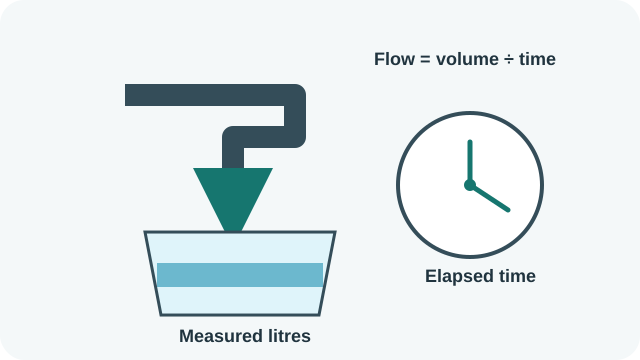
The result describes the average flow during the measurement. It can help estimate fill time: at a constant 15 L/min, a further 75 litres would take about 5 minutes. Real pumps may change with pressure, head height, filter condition or supply level, so the observed rate may not remain constant.
For equipment selection, compare the operating conditions as well as the number. A pump’s rated maximum may be measured under conditions unlike the installation. Pipe diameter, elevation and restrictions can reduce delivered flow.
Record the volume, duration, date and test conditions. Repeating the test provides more information than adding decimal places to one measurement. If readings vary, report a range or average and say how it was obtained.
Litres per minute is volume flow, not mass flow. Converting L/min to kilograms per minute requires the liquid’s density at relevant conditions.
Comparing repeated tests: suppose three one-minute collections produce 14.7, 15.2 and 15.0 litres. Their rates are 14.7, 15.2 and 15.0 L/min, with an average of about 14.97 L/min. Reporting the individual range alongside the average shows variation that a single result hides. If the test durations differ, add all collected litres and divide by the total minutes rather than taking a simple average of the rates.
For consumption over time, multiply rather than divide. A line running steadily at 15 L/min for 20 minutes delivers 300 litres. If it cycles on for only half of that period, the total depends on the actual on-time. This distinction matters when estimating tank capacity, irrigation use or process demand.