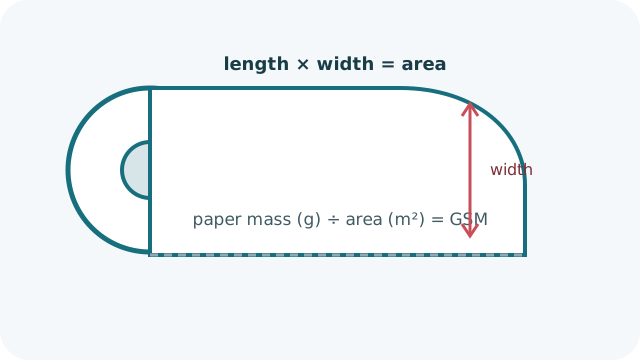
A result near a supplier’s nominal GSM can support an inventory check, but agreement does not prove the reel dimensions or mass are exact. Paper moisture, scale resolution, length estimation and manufacturing tolerance can all contribute to a difference.
A heavier GSM means more mass for the same surface area. It does not by itself specify caliper, stiffness, opacity, finish or strength because fibres and manufacturing methods differ. Compare those properties separately when choosing stock for printing or packaging.
The displayed whole number is appropriate only when the inputs justify that precision. Keep source measurements and any core deduction with the result. If a contract depends on grammage, follow the sampling and test method required by the parties rather than relying on a reel-level estimate alone.
For a better estimate, use a scale appropriate to the reel mass and measurements taken from the same reel state. A width printed on a label may be reliable, while remaining length may be only an equipment estimate. The least certain input often limits how confidently the final whole-number GSM can be used.
Grammage can also be checked from a smaller sample when an agreed test procedure is available: measure a known area and weigh it accurately. That method has its own sampling and conditioning requirements. Do not assume a small offcut represents an entire reel if coating or moisture varies across the stock.