Mathematics calculator

Time Percentage Calculator

Compare two durations—even when they use different units—and express the first as a percentage of the second.

Calculator inputs

Enter your values

Duration comparison
Calculated output

Result summary

Your result will appear here

Complete the required fields and select the calculate button.

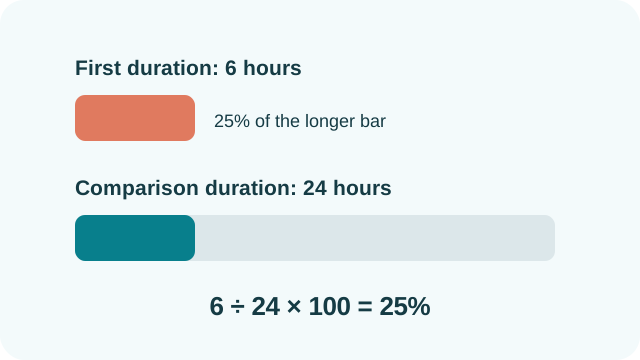
Two duration bars showing the first duration as a fraction and percentage of the second
Both durations are converted to hours before their ratio is changed into a percentage.

What is Time Percentage?

The Time Percentage Calculator tells you how much of one time period is represented by another. It is useful when checking how much of a workday a meeting used, what share of a training plan a session fills, or how much of a deadline has been assigned to one task. The two durations can use different units because the calculator converts them to a common basis before dividing.

The answer describes the first duration as a percentage of the second. That order matters: 30 minutes is 25% of two hours, while two hours is 400% of 30 minutes. Decide which duration is the part and which is the reference period before entering the figures.

How to Use This Calculator

  1. Enter the duration you want to measure in the first field and choose minutes, hours, days, weeks, or months.
  2. Enter the full or reference duration in the second field and choose its unit. The reference must be greater than zero.
  3. Select Calculate. The calculator converts both entries to hours, divides the first by the second, and multiplies by 100.
  4. Read the result with the original question in mind. A result below 100% means the first period is shorter; 100% means equal lengths; above 100% means it is longer.

For this calculator, a month is treated as 30 days. That convention is practical for estimates, but it may differ from a calendar month with 28, 29, or 31 days. When exact dates matter, first count the actual elapsed hours or days and enter that duration.

Formula Used

Time percentage = (first duration ÷ second duration) × 100

Both durations must be expressed in the same unit before division. The calculator uses 60 minutes per hour, 24 hours per day, seven days per week, and 30 days per month. Units cancel during division, leaving a percentage.

Variables Explained

ItemMeaningPractical check
First durationThe part or period being compared.It may be zero, but it cannot be negative.
Second durationThe reference or whole period.It must be greater than zero.
UnitMinutes, hours, days, weeks, or 30-day months.Choose the unit attached to each entered number.
ResultThe first duration as a share of the second.100% means the durations are equal.

Worked Example

Suppose a workshop lasts 90 minutes and the available training block lasts six hours. Convert six hours to 360 minutes, then calculate (90 ÷ 360) × 100 = 25%. The workshop uses one quarter of the block.

As a mixed-unit example, three days out of two weeks becomes 72 hours out of 336 hours. The calculation is (72 ÷ 336) × 100 = 21.4286%, so the three-day period takes about 21.43% of two weeks.

Why Use This Calculator?

A percentage describes proportion, not whether the time was well spent. A task using 70% of a schedule may be appropriate for the main activity or excessive for a minor one. Compare the output with the plan, contract, timetable, or capacity limit that gives it meaning.

Results above 100% are valid when the first duration exceeds the reference. For example, ten hours compared with an eight-hour shift is 125%, showing an overrun equal to 25% of the planned shift. When reporting, name both periods so readers know exactly what the percentage compares.

For planning, distinguish elapsed time from active work time. A two-hour appointment may include waiting, breaks, or setup, while a recorded task may contain only active minutes. Choose durations that answer the same question. For payroll or billing, follow the employer’s or contract’s rounding rules after calculating the unrounded share.

Common Mistakes

  • Reversing the durations and answering the opposite question.
  • Dividing minutes by hours without converting to a shared unit.
  • Assuming the calculator's 30-day month matches an exact calendar interval.
  • Entering a clock time such as 3:30 instead of a duration such as 3.5 hours.
  • Using zero for the reference duration, which makes division undefined.
  • Reading 125% as a 125% overrun; it represents the whole allowance plus a 25% overrun.

Frequently Asked Questions

Can the two times use different units?

Yes. Select the correct unit beside each entry. Both durations are converted to hours before the ratio is calculated.

What does a result over 100% mean?

The first duration is longer than the reference. A result of 140% means it is 1.4 times as long, or 40% longer.

How are months handled?

Each month is treated as 30 days. Use an exact day count when the differing lengths of calendar months affect your decision.

Can the first duration be zero?

Yes. Zero time is 0% of any positive reference duration. The second duration cannot be zero because it is the divisor.

Does 50% mean half the available time?

Yes, provided the second duration is the full available period. Always confirm that you entered the whole in the second field.

Why does swapping the entries change the answer?

Percentages have a direction. The first entry is measured against the second, so reversing them changes the denominator and answers a different question.

How many decimals should I report?

Use a level suited to the decision. Whole percentages often suit schedules, while two decimals may help with detailed time records.

Sources & References