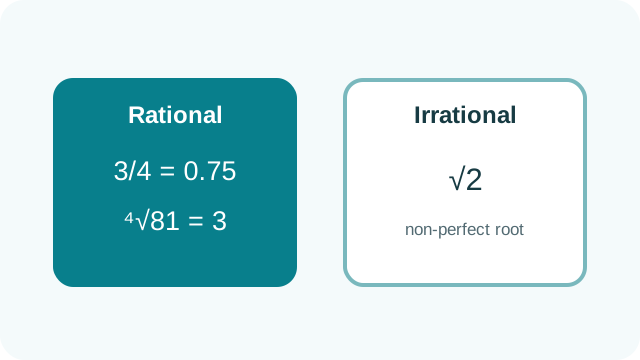
The classification describes the exact mathematical value, not merely the rounded decimal shown. A decimal such as 0.333333 on screen may represent the rational number 1/3 even though the display stops. Likewise, a six-decimal approximation to √2 does not turn √2 into a rational number.
This page’s root test is deliberately narrow: it accepts integer radicands and checks for perfect integer roots. More elaborate expressions may require algebraic simplification or a proof. A calculator approximation alone cannot establish that an arbitrary number is irrational.
Classification is about the exact value rather than its visual appearance. Integers are rational because any integer k equals k/1. Fractions of integers remain rational after reduction, including negative fractions. Irrational values can participate in operations that produce rational answers: for example, squaring √2 gives 2. Therefore, classify the final exact expression instead of deciding from one ingredient alone.
The numeric result is rounded to six decimal places. Use it to check size and sign, while relying on the stated perfect-root reasoning for the classification. Writing the original expression beside an assignment or proof preserves information that a decimal approximation loses.