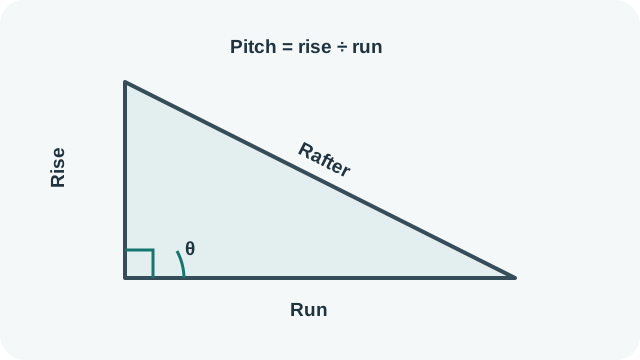
Roof pitch describes vertical rise compared with horizontal run. This calculator expresses the same slope as an angle, a percentage and inches of rise per 12 inches of run, and it finds the straight rafter length for the measured right triangle. It accepts mixed length units and converts both inputs to metres before calculating. The geometry helps check measurements and compare slopes; it does not select roofing materials, framing sizes or fall protection.
Roof Pitch Calculator
Calculate roof angle, slope percentage, pitch ratio, and rafter length from rise and run.
Roof measurements
SlopeEnter rise and run
Pitch summary
Your result
Your roof pitch will appear here
Enter the vertical rise and horizontal run, then calculate the roof geometry.
Roof pitch ratioRise for every 12 units of horizontal run
- Rafter length
- 0 m
- Pitch angle
- 0°
- Slope
- 0%
- Pitch ratio
- 0:12
The rafter result is the straight-line length for the entered rise and run, before overhangs or construction allowances.
What is Roof Pitch?
How to Use This Calculator
- Measure the vertical rise and select centimetres, metres, feet or inches.
- Measure the matching horizontal run, not the distance along the sloping roof, and choose its unit. The run must be greater than zero.
- Select Calculate. The page converts both lengths to metres, applies the Pythagorean theorem for rafter length, uses arctangent for the angle, and scales rise divided by run for percentage and x:12 pitch.
Rise and run must describe the same roof section. A full building span is not the run of one symmetrical roof side; for a ridge centered over the walls, the horizontal run is usually half the span, subject to overhang and the exact points measured.
Formula Used
Rafter length = √(rise² + run²).
Angle = arctan(rise ÷ run).
Pitch percentage = rise ÷ run × 100.
Rise per 12 = rise ÷ run × 12.
Rise and run must first use the same length unit. The page reports rafter length in metres because it converts the input triangle to metres.
Variables Explained
| Item | Meaning |
|---|---|
| Rise | The vertical change between the lower and upper measurement points. |
| Run | The horizontal distance between those points, measured level. |
| Rafter length | The ideal straight hypotenuse of the rise-run triangle, reported in metres. |
| Pitch angle | The slope’s angle above horizontal in degrees. |
| x:12 pitch | Vertical rise corresponding to 12 units of horizontal run. |
Worked Example
For a 1 m rise over a 4 m horizontal run, rafter length is √(1² + 4²) = √17 = 4.123 m. The angle is arctan(1 ÷ 4) = 14.04°. Percentage pitch is 1 ÷ 4 × 100 = 25%. The common x:12 expression is 1 ÷ 4 × 12 = 3, so the same slope is 3:12.
Why Use This Calculator?
A 3:12 result means the roof rises 3 units for every 12 horizontal units; it does not mean a three-degree angle. The 25% value likewise describes a ratio, while 14.04° is an angular measure. Converting between these forms is useful when drawings, suppliers and local requirements use different conventions.
The rafter result is a geometric line between measurement points. Practical member length may need an overhang, ridge or birdsmouth details, bearing allowances, cuts and waste. Roofing area also depends on building width, roof layout and penetrations. Check plans and material instructions rather than ordering from the hypotenuse alone.
Roof work presents a serious fall hazard. OSHA uses slope definitions for safety rules, but a calculator result does not identify the fall-protection system required for a site. Measurements at height should be made by trained people using appropriate procedures. Local codes and product limits determine acceptable assemblies.
Measurement accuracy sets the useful precision of every output. A small error in a short run can shift the ratio noticeably, so measure over a longer level distance where conditions allow and verify that the level reference is truly horizontal. Sagging roof surfaces and uneven framing may produce different local readings. For an existing roof, take several safe measurements rather than assuming one point represents the whole plane. Keep the raw rise and run with the result so another person can reproduce the conversion and decide how much rounding is reasonable.
Common Mistakes
- Using the sloping rafter distance as run instead of measuring horizontally.
- Entering rise in inches and run in feet while selecting the same unit for both.
- Confusing a 25% slope with a 25° angle.
- Using full building span where the triangle needs one side’s horizontal run.
- Treating geometric rafter length as a cut list without construction allowances.
Frequently Asked Questions
What is the difference between run and rafter length?
Run is horizontal. Rafter length follows the slope and is the hypotenuse of the right triangle formed with rise.
Can rise and run use different units?
Yes, if each selector matches its entered measurement. The page converts both to metres before forming the ratio.
What does 6:12 pitch mean?
It means six units of vertical rise for every twelve horizontal units of run. The units can be inches, centimetres or another shared unit.
Why is percentage different from degrees?
Percentage is rise divided by run multiplied by one hundred. Degrees come from the arctangent of that ratio, so the numbers are not interchangeable.
Does rafter length include an eave overhang?
Only if the entered run includes the overhang’s horizontal projection. The output contains no automatic allowance for cuts or connections.
Can this result determine safe roofing work methods?
No. Slope is only one factor. Follow applicable safety requirements and a site-specific plan prepared by qualified people.
Why does the page report metres?
Both inputs are converted to metres before the hypotenuse is calculated, so the length result uses metres even when the original entries use other units.