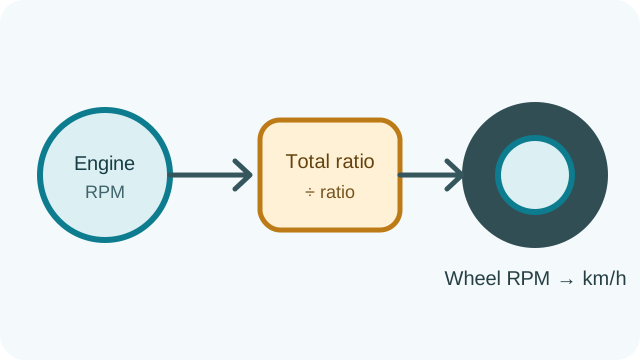
A lower numerical overall ratio produces more wheel RPM for the same engine RPM and therefore a higher theoretical speed. A higher ratio produces fewer wheel turns and lower speed, usually with greater torque multiplication. Whether a ratio is described as “higher” or “lower” can be ambiguous, so compare the actual numbers.
For closer estimates, use measured rolling circumference: mark the tire, roll the loaded vehicle through several revolutions, measure distance, and average per turn in a safe controlled setting. Manufacturer revolutions-per-mile data can also be useful. Never use this page while driving, and do not use a theoretical result to exceed tire, engine, transmission, or legal speed limits.
Ratio changes can be compared without recalculating every physical detail. If the overall ratio changes from 3.00 to 3.60 while RPM and tire stay fixed, wheel RPM and speed are multiplied by 3.00/3.60, or about 0.833. Tire changes scale directly with diameter in this simplified model.
A tire’s sidewall size is not itself the outside diameter. Deriving diameter from a metric tire code requires section width, aspect ratio, and wheel diameter, and the result is still nominal. Manufacturer specifications or a loaded-circumference measurement are preferable when precision matters.