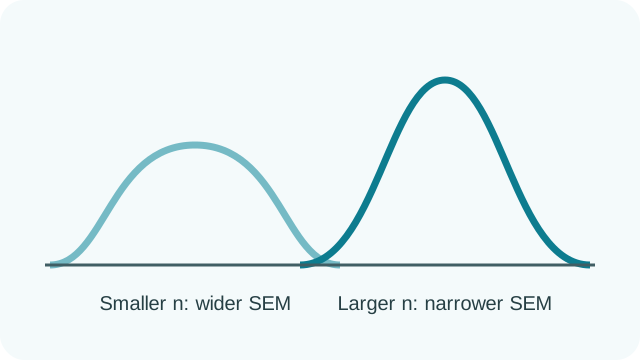
A smaller standard error means the sample mean is more stable across repeated samples, not that the observations themselves have become less variable. The result keeps the original measurement unit: if σ is 12 grams, the standard error is 2 grams.
Increasing sample size gives diminishing returns because precision improves with √n. To cut standard error in half while σ stays fixed, four times as many independent observations are needed. A tiny standard error can still accompany selection bias or systematic measurement error. For non-independent data, using the raw row count as n often understates uncertainty. When σ is estimated, distinguish descriptive calculation from the inferential procedure chosen for the study.
The formula is especially useful for planning comparisons because it makes the precision-versus-sample-size tradeoff visible. If σ = 12 and n = 36, increasing n to 144 reduces the standard error from 2 to 1. Reaching 0.5 would require n = 576 under the same assumptions. That arithmetic does not decide whether the extra observations are worth their cost, and it assumes new observations add independent information. Repeated measurements on the same unit may improve measurement precision, yet they are not automatically equivalent to observations from new independent units.