Sine and cosine always lie from −1 through 1 for real angles. Their reciprocals therefore have absolute value at least one wherever defined. Tangent and cotangent may take any finite real value.
Quadrants determine signs. In quadrant I all are positive; in quadrant II sine and cosecant are positive; in quadrant III tangent and cotangent are positive; in quadrant IV cosine and secant are positive.
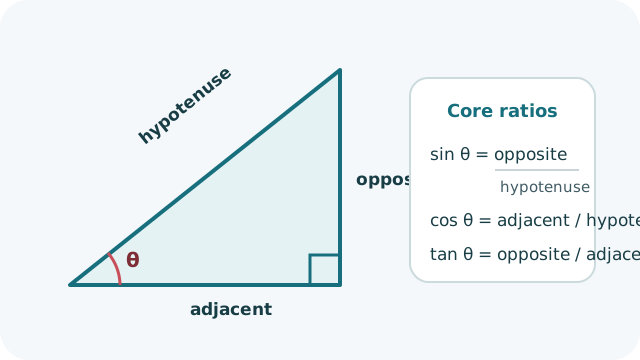
Right-triangle side language is most direct for acute angles. The unit circle extends the same functions to negative angles and angles beyond 90°, where signed coordinates replace physical side lengths.
Near a zero denominator, a small angle change can produce a very large result. Measurement uncertainty and rounding therefore matter near 90° multiples for tangent and secant, and near 180° multiples for cotangent and cosecant.
Do not confuse reciprocal functions with inverse functions. Secant is one divided by cosine, whereas arccos returns an angle. Superscript minus-one notation can be ambiguous without context.
Eight decimals are display precision, not evidence that the entered angle is exact. Keep enough digits for a longer calculation, then round according to the source measurements.
Identity checks include sin²θ + cos²θ = 1, sec²θ = 1 + tan²θ, and csc²θ = 1 + cot²θ wherever all involved functions are defined.
Angles that differ by 360 degrees are coterminal, so all six values repeat. Sine, cosine, secant, and cosecant have fundamental period 360 degrees; tangent and cotangent repeat every 180 degrees. These periodic rules provide quick checks for large or negative inputs.
Special-angle exact forms such as √3/2 may be preferable in algebra, while the page displays decimals. A rounded decimal can verify magnitude and sign but should not replace an exact form when a problem explicitly requests one.
In applied work, confirm which angle a diagram defines and which side is opposite it. The same physical triangle has two acute angles, and exchanging them swaps sine with cosine and tangent with cotangent.
For coordinates on a circle of radius r, cosine supplies the horizontal coordinate divided by r and sine supplies the vertical coordinate divided by r. This picture explains both signs and the identity sin²θ + cos²θ = 1. It also shows why neither sine nor cosine can exceed one in absolute value.