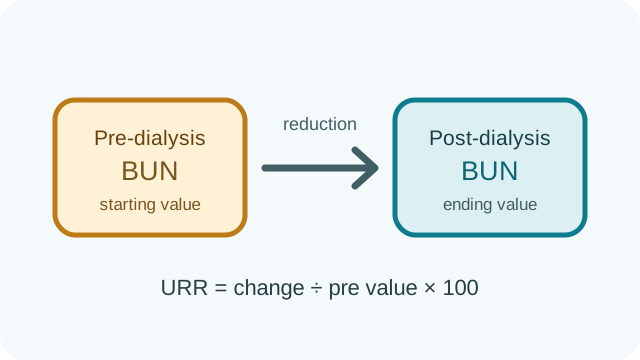
The urea reduction ratio (URR) describes the percentage decrease in blood urea nitrogen during one hemodialysis treatment. It compares a properly collected pre-dialysis value with a properly collected post-dialysis value. The calculator accepts mg/dL or mmol/L and converts values when the units differ. URR is one measure of delivered dialysis dose, but it does not describe every part of treatment adequacy, fluid management, nutrition, access performance, symptoms, or residual kidney function. Results belong in a dialysis team’s review and should never be used to change treatment time, frequency, or prescription without clinical direction.
URR Calculator — Urea Reduction Ratio
Calculate the percentage reduction in blood urea nitrogen between pre- and post-dialysis measurements.
BUN measurements
URR
Enter pre- and post-dialysis values
Dialysis summary
Calculated reduction ratio
The urea reduction ratio will appear here
Use measurements from the same dialysis session and select each unit.
Urea reduction ratioURR = (pre BUN − post BUN) ÷ pre BUN × 100
- Urea reduction ratio
- 0%
- Pre-dialysis value
- 0 mg/dL
- Post-dialysis value
- 0 mg/dL
- Absolute reduction
- 0 mg/dL
Educational estimate only. It is not medical advice, a diagnosis, or a substitute for assessment by a qualified healthcare professional. Dialysis adequacy assessment uses clinical protocols, timing, access, symptoms, and other measures beyond this ratio.
What is URR Calculator?
How to Use This Calculator
- Use BUN samples collected before and after the same hemodialysis session according to the dialysis unit’s sampling procedure.
- Enter the positive pre-dialysis result and choose its unit.
- Enter the nonnegative post-dialysis result and choose its unit. The post-treatment value must not exceed the converted pre-treatment value in this calculation.
- Choose Calculate to obtain the percentage reduction.
- Review the value with the dialysis team alongside Kt/V, session length, access function, fluid removal, treatment frequency, laboratory results, symptoms, and the prescribed goal.
Post-treatment sampling technique matters. Recirculation or sampling too soon or in the wrong manner can change the apparent BUN reduction. Use values supplied for adequacy assessment rather than unrelated laboratory results from different days.
Formula Used
When needed, mmol/L is placed on the same BUN scale using:
BUN (mg/dL) = urea nitrogen (mmol/L) × 2.801
Then:
URR (%) = (pre-dialysis BUN − post-dialysis BUN) ÷ pre-dialysis BUN × 100
The units cancel once both measurements use the same scale, so matching mg/dL inputs or matching mmol/L inputs give the same ratio without conversion. The result is rounded to two decimal places. URR does not correct for urea generation, treatment time, or the effect of fluid removal on concentration.
Variables Explained
| Value | Meaning |
|---|---|
| Pre-dialysis BUN | Blood urea nitrogen concentration collected before the treatment being assessed. |
| Post-dialysis BUN | Concentration collected after that same treatment using the prescribed sampling method. |
| mg/dL | Milligrams of urea nitrogen per decilitre. |
| mmol/L | Urea concentration in millimoles per litre; converted to BUN-equivalent mg/dL when units differ. |
| URR | Percentage decrease from the pre-treatment concentration. |
| Kt/V | A different dialysis-dose measure that uses additional treatment and body-volume information. |
Worked Example
If pre-dialysis BUN is 60 mg/dL and post-dialysis BUN is 18 mg/dL, the decrease is 60 − 18 = 42 mg/dL. Divide by the starting value: 42 ÷ 60 = 0.70. Multiply by 100 to obtain a URR of 70.00%. Entering equivalent concentrations in another supported unit produces the same percentage. This example demonstrates the arithmetic only; it does not establish an individualized dialysis target or show whether sampling and treatment conditions were appropriate.
Why Use This Calculator?
A higher URR means a larger fraction of the measured urea concentration fell during the session. National Kidney Foundation material notes that care teams often look for at least 65% for many people receiving in-center hemodialysis three times weekly. That figure is context-dependent, not a universal pass/fail line. More frequent schedules, residual kidney function, unusual volume changes, and individualized prescriptions can change how a result should be understood.
One URR cannot show why a value is low or high. Shortened treatment, blood-flow or dialysate-flow issues, access recirculation, sampling errors, and other factors may contribute. Contact the dialysis team about an unexpected result. Seek urgent medical help for severe shortness of breath, chest pain, confusion, fainting, uncontrolled bleeding, or another emergency rather than relying on a calculator.
Common Mistakes
- Using samples from different treatments breaks the intended before-and-after comparison.
- Mixing mg/dL and mmol/L without conversion produces a meaningless ratio.
- Entering a zero pre-treatment value causes division by zero and is not physiologically suitable.
- Treating URR as the percentage of all body waste removed overstates what the measurement represents.
- Assuming a single threshold fits every dialysis schedule ignores the prescribed treatment context.
- Changing treatment based on a self-calculated result can be dangerous.
- Ignoring post-dialysis sampling instructions can make access recirculation or rebound distort the result.
Frequently Asked Questions
Is URR the same as Kt/V?
No. Both are used to discuss dialysis dose, but Kt/V incorporates clearance, time, and urea distribution volume, while URR is a simple percentage change in BUN.
What URR is considered adequate?
For many people receiving in-center hemodialysis three times weekly, teams often look for at least 65%. The prescribed goal can differ, so ask the treating team.
Why must both samples come from the same session?
URR is intended to measure the concentration change across one treatment. Values from different days include unrelated changes in diet, fluid, metabolism, and timing.
Can I mix mg/dL and mmol/L?
Yes, if each unit is selected correctly. The calculator converts mmol/L to the same BUN scale before computing the ratio.
What if post-dialysis BUN is higher?
That pattern does not fit an ordinary reduction calculation and may reflect entry, unit, timing, or sampling problems. Recheck the report and contact the dialysis team.
Does a good URR mean dialysis is working perfectly?
No. Adequacy also involves symptoms, fluid and blood-pressure control, access function, other laboratory values, treatment attendance, nutrition, and the individual prescription.
Should I change a dialysis session after calculating URR?
No. Do not shorten, extend, skip, or otherwise change prescribed treatment based on this page. Discuss results with the dialysis clinician.
Sources & References
The National Kidney Foundation — Hemodialysis and URR provides the URR formula, discusses its relation to Kt/V, and cites KDOQI guidance. The foundation’s current hemodialysis overview explains how URR fits with other treatment and health information. These references support education and clinician discussion; a dialysis prescription must remain individualized.