The Warsaw Method Calculator converts fat and protein energy into fat-protein units used in an extended-bolus model for some people with type 1 diabetes.
Warsaw Method Calculator
Apply the page’s fat-protein-unit arithmetic to fat, protein, and an insulin-to-carbohydrate ratio.
Meal and ratio inputs
FPU
Enter fat, protein, and I:C ratio
Model summary
Educational estimates
The model output will appear here
Use only a ratio already established by a qualified diabetes-care professional.
Modelled insulin amount(fat kcal + protein kcal) ÷ 10 ÷ I:C ratio
- Modelled insulin
- 0 units
- Fat-protein units
- 0
- Carbohydrate equivalent
- 0 g
- Fat + protein energy
- 0 kcal
- Modelled extension
- —
Educational estimate only. It is not medical advice, a diagnosis, or a substitute for assessment by a qualified healthcare professional. This page must not be used to start, change, or deliver insulin. Dosing errors can cause severe hypoglycemia or hyperglycemia.
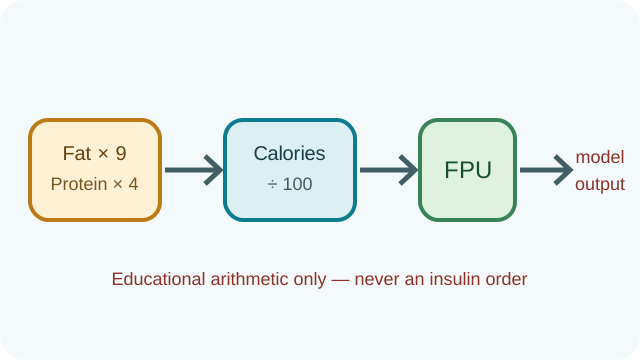
Table of Contents
1
What is Warsaw Method?
2
How to Use This Calculator
- Enter or select Fat, Protein, Insuline to Carb Ratio.
- Check the unit beside each measurement. For a percentage or rate, use the scale and time period stated in the form.
- Choose Calculate, then compare the output with the formula and example below. If you change a value or option, calculate again to update the result.
For this Warsaw fat-protein unit calculation, read each field label before entering data and keep a copy of the original values. Recalculate after changing any input; the displayed result is based only on the current submission.
3
Formula Used
FPU = (9 × fat grams+4 × protein grams)/100.
The endpoint converts milligrams to grams, calculates fat energy as 9 kcal/g and protein energy as 4 kcal/g, then divides their sum by 100. It treats each FPU as a 10 g carbohydrate equivalent and divides that equivalent by the entered insulin-to-carbohydrate denominator.
4
Variables Explained
| Input or term | Meaning |
|---|---|
| Fat | Meal fat converted to grams. |
| Protein | Meal protein converted to grams. |
| IC ratio | Grams of carbohydrate covered by one insulin unit. |
| FPU | One hundred kcal from fat and protein. |
| Carbohydrate equivalent | Ten grams for each modeled FPU. |
| Extended time | Categorical duration from the page method. |
5
Worked Example
For 20 g fat, 25 g protein and an insulin-to-carbohydrate ratio of 1 unit per 10 g, fat and protein supply 180 + 100 = 280 kcal. That is 2.8 FPUs, a modeled 28 g carbohydrate equivalent and 2.8 units under this method. The page assigns the greater-than-2 and up-to-3 FPU duration of five hours.
6
Why Use This Calculator?
This method was developed for pump users with type 1 diabetes to address delayed glucose effects from mixed meals. It is not a standard dose suitable for everyone, and the page does not include the meal’s ordinary carbohydrate bolus.
Published reviews report uncertainty and increased hypoglycaemia in some studies using the Pankowska equation. Insulin sensitivity, meal composition, active insulin, exercise and pump settings can change the response.
The entered ratio means grams of carbohydrate covered by one unit. Enter 10 for a 1:10 ratio, not 0.1 or the number of units used at another meal. Ratios may change by time of day.
The duration bands are categorical implementation rules: up to 1 FPU gives three hours, over 1 through 2 gives four, over 2 through 3 gives five, and more than 3 gives six to eight hours. They are not a personal prescription.
Review continuous-glucose data and any adjustment method with the diabetes team. Incorrect extra insulin or timing can cause severe hypoglycaemia; urgent symptoms require immediate treatment under the person’s emergency plan.
Record enough context to reproduce this Warsaw fat-protein unit calculation: input source, unit, date and any method choices. A bare number is easy to misread when it is copied into a report or compared later.
Round for communication only after the calculation. The endpoint formatting improves readability but does not increase the accuracy of the measurements, assumptions or source data.
Food-label values are estimates and serving-size errors flow directly into the FPU result. Weighing a portion can improve the arithmetic, but it cannot remove biological variation in digestion or glucose response.
The displayed insulin number is rounded to two decimals even though many delivery devices cannot deliver every hundredth of a unit. Never turn that formatted number into a dose without the individualized settings, rounding rules and safety instructions provided by the diabetes team.
High-fat meals can delay gastric emptying and alter the timing of post-meal glucose. Protein effects also depend on whether carbohydrate is present. Combining both nutrients in one 100-kcal unit is a deliberate simplification of the Warsaw model.
7
Common Mistakes
- Using milligrams as grams.
- Entering insulin units instead of the ratio denominator.
- Including carbohydrate calories in the FPU numerator.
- Treating the estimate as a dose instruction.
- Ignoring active insulin and exercise.
- Assuming the duration fits every pump or meal.
- Rounding food data too early.
8
Frequently Asked Questions
Does this include the carbohydrate bolus?
No. It models only the additional fat-and-protein component described by this method.
What does 1 FPU mean here?
It is 100 kcal from fat and protein.
How do I enter a 1:12 ratio?
Enter 12 in the ratio field.
Can the estimate cause low glucose?
Yes. Extra insulin can cause hypoglycaemia, and published evidence does not support unsupervised universal use.
Why is the bolus extended?
The method attempts to match delayed glucose effects of fat and protein, but personal timing varies.
Can injection users apply this output?
The duration labels were designed around extended pump delivery and should not be translated without clinical guidance.
Is the displayed amount a prescription?
No. It is a transparent calculation for discussion with a qualified diabetes team.
9