Angle of Depression Calculator

Form

Results

Angle of depression

0

1

What is Angle of Depression?

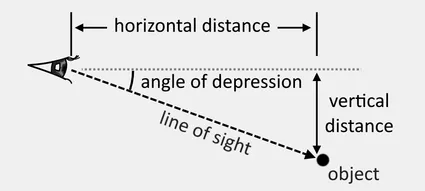
An angle of depression describes a downward line of sight measured from a horizontal line through the observer. Looking from a balcony toward a point on level ground creates a right triangle: the vertical drop is one leg, the horizontal separation is the other and the line of sight is the sloping side.

This calculator finds the angle from the two perpendicular distances. It accepts different length units and converts them before forming their ratio. It is useful for checking a trigonometry exercise or a simple geometric estimate, provided the distances correspond to the right triangle described here. It does not measure a camera angle directly or account for terrain, refraction or the curvature of the Earth.

2

How to Use This Calculator

  1. Identify the observer’s viewing height and the target’s height on the same vertical reference. Their difference is the vertical distance needed by the calculator.
  2. Measure or obtain the horizontal separation between the observer and target. This is the level distance, not the diagonal distance along the line of sight or the length of a sloped path.
  3. Enter the two distances with their correct unit selections. Centimetres, inches, kilometres, metres and feet are available, and the inputs may use different units.
  4. Choose Calculate. The result is given in degrees, rounded to two decimal places, using inverse tangent of vertical distance divided by horizontal distance.
  5. Check the result against the geometry. Equal positive distances should give 45°, a relatively small drop should give a shallow angle, and a large drop over a short horizontal separation should give a steep angle.
3

Formula Used

θ = arctan(vertical drop/horizontal distance). The calculator converts the inverse-tangent result from radians to degrees: degrees = radians×180/π.
4

Variables Explained

InputMeaning in this calculator
Vertical distanceDifference in height from the observer’s eye or instrument to the target. Use the drop to the target, rather than automatically using an entire building’s height.
Horizontal distanceLevel separation perpendicular to the vertical drop. It must be positive for the ordinary triangle calculation used here.
Distance unitsUnits attached to each input, converted internally to metres before division.
Angle outputAngle below the observer’s horizontal line. It is not the angle from a vertical wall, which would be complementary in a right triangle.
5

Worked Example

An observer’s eye is 10 m above a target and the horizontal separation is 20 m. The ratio is 10/20 = 0.5. The inverse tangent is approximately 0.46365 radians. Multiplying by 180/π gives 26.565°, displayed as 26.57°. The downward line of sight is therefore about 26.57° below horizontal.

For a unit check, enter the same vertical drop as 1,000 cm and leave the horizontal distance at 20 m. The result is unchanged because 1,000 cm converts to 10 m. If instead a 10 m building has an observer’s eye another 1.5 m above its roof and the target is at ground level, the actual drop would be 11.5 m. At 20 m horizontally, that produces about 29.90°. Choosing the correct measurement points matters more than retaining extra decimal places.

6

Why Use This Calculator?

For positive distances, this expression produces an angle between zero and ninety degrees. The angle approaches zero as the vertical drop becomes small compared with horizontal distance. It approaches ninety as the horizontal distance becomes very small compared with the drop. A horizontal distance of exactly zero makes the division in the current implementation invalid, even though a directly downward line of sight has a clear geometric interpretation.

The angle of elevation from the target back toward the observer is equal to the angle of depression when both horizontal references are parallel. That equality concerns the same ideal triangle. It does not mean the angle is measured from the ground surface if the ground slopes. For a field estimate, include uncertainty in the measured drop and separation. The output rounds the calculation; it cannot remove errors in heights, distances or assumptions about the scene.

7

Common Mistakes

    • Do not put a diagonal line-of-sight distance into the horizontal field. That calls for a different trigonometric relationship.
    • Do not confuse height above the ground with vertical separation if the target is itself elevated.
    • Do not measure the angle from vertical and compare it directly with this below-horizontal result.
    • Do not enter a zero horizontal distance, or use negative distances as though the page were a full coordinate-bearing calculator.
8

Frequently Asked Questions

Why does the calculator use tangent?

In the right triangle, the vertical drop is opposite the angle at the observer, and the horizontal distance is adjacent. Tangent equals opposite divided by adjacent. Inverse tangent reverses that ratio to recover the angle, which is why a sloping-distance input would not fit the same expression.

What if I know the diagonal distance instead?

If the diagonal distance and vertical drop are known, a sine relationship can find the angle, or the Pythagorean theorem can first find horizontal separation. This page expects the horizontal leg. Do not relabel the diagonal as horizontal merely because both are lengths.

Can the angle be 45 degrees?

Yes. When positive vertical and horizontal distances are equal after conversion, their ratio is one and arctan(1) is 45°. Entering 5 m vertically and 500 cm horizontally is a convenient unit-conversion check because those distances are equal.

Is angle of depression the same as slope percentage?

They describe related geometry but use different scales. The slope magnitude here is vertical/horizontal, and multiplying that ratio by 100 gives a percentage. The angle is the inverse tangent of the ratio. A 100% slope corresponds to 45°, not 100°.

Does a longer horizontal distance always reduce the angle?

For a fixed positive vertical drop, yes. Increasing the horizontal denominator lowers the ratio and therefore lowers its inverse tangent. If both distances change, compare their ratio; doubling both leaves the angle unchanged even though the triangle becomes larger.

9

Sources & References