Concrete Estimator Tube Calculator

Form

pieces

Results

Volume
0 m³
1

What is Concrete Estimator Tube?

The concrete tube calculator estimates the volume of material in a hollow cylinder. It subtracts the inner cylindrical opening from the outside cylinder, then multiplies by the number of identical pieces. This is useful for checking a ring-shaped concrete section before discussing material quantities with a supplier.

The result represents concrete in the wall of the tube, not the empty space inside it. A tube with a large opening can have a much smaller material volume than a solid cylinder of the same outside size. The calculator assumes a uniform circular cross-section, constant wall thickness, and a straight height.

2

How to Use This Calculator

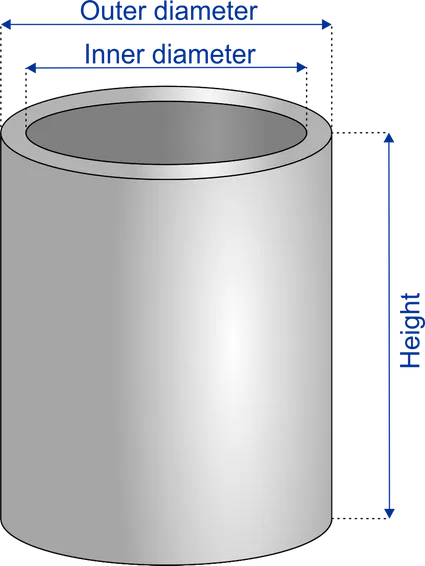
Measure the outside diameter across the centre of the tube. Measure the inside opening across the centre in the same way. Enter each value with its own selected unit. The outer-diameter field offers centimetres, metres, feet, and inches; the inner-diameter and height selectors offer metres, feet, and inches. Convert centimetres to metres yourself when the relevant selector does not offer centimetres.

Enter the height or axial length of one piece. For a horizontal pipe, this is its length along the pipe, not the height it reaches above the ground. Then enter Quantity as the number of identical pieces and choose Calculate.

The visible result is total volume in cubic metres, rounded to three decimal places. Compare the inner and outer measurements after accounting for units: the outer diameter must exceed the inner diameter for a hollow tube with positive wall thickness. Use a positive height and a whole-number quantity for a count of physical pieces.

3

Formula Used

For one tube, V = πh(R² − r²), where R is the outside radius and r is the inside radius. Since a radius is half a diameter, the same formula is V = πh(D² − d²)/4.

For q identical tubes, total volume = qπh(D² − d²)/4. All lengths are converted to metres first, so the resulting volume is in cubic metres. Feet are multiplied by 0.3048 and inches by 0.0254. Squaring a diameter and multiplying by height explains why the result is a cubic unit.

If wall thickness w is known instead of the inner diameter, d = D − 2w. The thickness appears on both sides of a cross-section, so subtracting it only once gives the wrong opening size.

4

Variables Explained

Symbol or inputMeaning in this calculator
D: outer diameterFull outside width through the centre of the circular section, not the outside radius.
d: inner diameterFull width of the empty opening. Use zero only when modeling a solid cylinder.
h: heightLength along the cylinder axis; constant throughout the section being estimated.
q: quantityNumber of identical tubes. Different sizes should be calculated separately.
V: concrete volumeMaterial outside the inner opening and inside the outer surface, before any ordering allowance.
5

Worked Example

Take one tube with an outside diameter of 1 m, an inside diameter of 0.8 m, and a height of 1 m. The radii are 0.5 m and 0.4 m. Their squared difference is 0.25 − 0.16 = 0.09 m².

Multiplying by π and the 1 m height gives approximately 0.282743 m³. The calculator displays 0.283 m³. This tube has a wall thickness of (1 − 0.8)/2 = 0.1 m, or 10 cm.

For three identical tubes, the total before rounding is approximately 0.848230 m³, displayed as 0.848 m³. Multiplying the individually rounded 0.283 by three gives 0.849 instead, which illustrates why the total should be calculated before rounding.

As another check, the complete outside cylinder occupies approximately 0.785398 m³ and the opening occupies approximately 0.502655 m³. Subtracting the opening gives the same 0.282743 m³ of concrete.

6

Why Use This Calculator?

Use the result as a geometric material quantity. It does not tell you the tube's load capacity, required concrete strength, reinforcement arrangement, or suitability for a buried installation. Those depend on the intended use and design, none of which is entered here.

The formula excludes end caps, collars, flanges, sockets, bases, and enlarged footings. Add those shapes separately if they are part of the pour. It also assumes that the inside and outside surfaces maintain constant diameters over the full height; tapered or irregular sections need a different volume model.

A cubic metre is 1,000 litres, so the first example contains about 282.743 litres of geometric concrete volume before rounding. This does not directly determine a number of dry-mix bags. For bags, divide the required wet-concrete volume by the manufacturer's stated yield per bag, using the same units, then decide ordering quantities separately.

Small objects may round to 0.000 m³ even though their volume is positive. Retain the unrounded formula result for such work rather than interpreting the rounded display as an empty requirement.

7

Common Mistakes

    Do not enter a radius into a diameter field. Because both diameters are squared, halving both by mistake reduces the computed volume to one quarter of the correct value. Likewise, a nominal product diameter may not equal the actual outside or inside diameter needed by the formula.

    Do not reverse the diameters or use a negative height. The current calculator does not enforce all of these physical restrictions and can produce a negative quantity from impossible dimensions. Equal diameters represent zero wall thickness, not a usable concrete tube. Check measurements instead of ordering from that output.

8

Frequently Asked Questions

Can I calculate a solid concrete column?

Mathematically, yes: set the inner diameter to zero. The formula then becomes the usual solid-cylinder volume. This gives quantity only and does not verify the column’s structural design.

Does Quantity add an allowance for waste?

No. It multiplies the exact geometric volume by the count entered. Any allowance for losses or uncertainty must be considered separately for the actual project.

What if I know wall thickness but not the opening size?

Subtract twice the wall thickness from the outside diameter, using consistent units. An outside diameter of 1 m with a 0.1 m wall has an inside diameter of 0.8 m.

Can the tube be lying horizontally?

Yes. Orientation does not change the geometric volume. Enter the length along its axis in Height; do not enter the outside diameter again simply because the tube is horizontal.

9

Sources & References