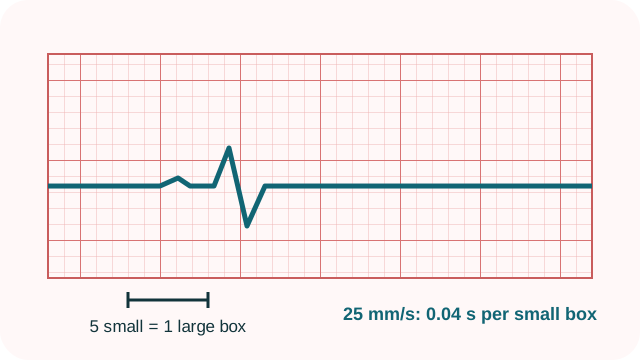
Convert small or large ECG paper boxes to elapsed time at 25 or 50 millimetres per second.
Paper measurement
Enter boxes and calibration
ECG
Timing summary
Calculated duration
The elapsed time will appear here
Confirm both paper speed and whether you counted small or large boxes.
Elapsed timeboxes × seconds per box at selected speed
Elapsed time
0 seconds
Boxes counted
0
Box size
—
Paper speed
—
Time per box
0 seconds
Educational estimate only. It is not medical advice, a diagnosis, or a substitute for assessment by a qualified healthcare professional. Always verify the calibration printed on the ECG; this page does not interpret the tracing.
At 25 mm/s, one small box is 0.04 seconds and one large box is 0.20 seconds.
This calculator converts a horizontal span on electrocardiogram paper from grid boxes to seconds. It supports small 1 mm boxes and large 5 mm boxes at paper speeds of 25 mm/s and 50 mm/s. The conversion is geometry and time scaling; it does not identify a rhythm, diagnose a condition or say whether an interval is normal.
Always read the calibration printed on the tracing. Standard teaching commonly uses 25 mm/s, where one small box represents 0.04 seconds and one large box represents 0.20 seconds. At 50 mm/s the paper moves twice as fast, so the same widths represent 0.02 and 0.10 seconds respectively.
2
How to Use This Calculator
Confirm the paper speed on the ECG rather than guessing from appearance.
Count the horizontal boxes across the interval. Choose Small for 1 mm boxes or Big for 5 mm boxes and enter the count, including a decimal estimate if an endpoint falls between grid lines.
Select 25 mm/s or 50 mm/s and calculate. The result is elapsed time in seconds.
Count horizontally along the time axis. Vertical height represents voltage and cannot be converted to seconds with this tool. A box count of zero is allowed and returns zero; negative counts and unsupported calibration choices are rejected. Image resizing can distort a photographed or scanned trace, so use the original grid or a viewer that preserves scale.
3
Formula Used
Time (seconds) = horizontal distance (mm) ÷ paper speed (mm/s)
Horizontal distance is box count × box width. A small box is 1 mm wide and a large box is 5 mm wide. Therefore, at 25 mm/s: small-box time = count × 0.04 s and large-box time = count × 0.20 s. At 50 mm/s: small-box time = count × 0.02 s and large-box time = count × 0.10 s.
4
Variables Explained
Supported ECG grid conversions
Input
Meaning
Supported values
Number of boxes
Horizontal grid span across the interval being measured.
Zero or a positive number; partial boxes may be entered as decimals.
Box type
Small means 1 mm wide; big means one 5 mm group of five small boxes.
Small or Big.
Paper speed
How quickly the recording paper or screen scale advances.
25 mm/s or 50 mm/s.
Duration
Elapsed time represented by the selected horizontal span.
Seconds, rounded to four decimal places when needed.
5
Worked Example
Suppose an interval spans 7.5 small boxes on a trace marked 50 mm/s. Each small box is 0.02 seconds, so duration = 7.5 × 0.02 = 0.15 seconds, or 150 milliseconds. The same 7.5 small boxes at 25 mm/s would represent 0.30 seconds.
For a second example, four large boxes at 25 mm/s equal 4 × 0.20 = 0.80 seconds. You could reach the same answer by noting that four large boxes span 20 mm and calculating 20 mm ÷ 25 mm/s = 0.80 s.
6
Why Use This Calculator?
The output is only a duration. What that duration represents depends on where the measurement begins and ends: it could be an R–R interval, PR interval, QRS width, QT interval or another span. Each has its own measurement convention and clinical context. Small errors in choosing endpoints can matter, especially for short waveforms.
Do not use this conversion alone to decide that an ECG is normal or abnormal. Rhythm regularity, lead selection, waveform quality, patient factors, device calibration and clinical symptoms all affect interpretation. A clinician should evaluate concerning findings. Seek urgent medical help for symptoms such as chest pain, severe shortness of breath, fainting or another emergency rather than relying on a grid calculation.
7
Common Mistakes
Assuming every trace runs at 25 mm/s; some recordings use 50 mm/s.
Counting large boxes but selecting Small, causing a fivefold error.
Measuring vertical amplitude instead of horizontal time.
Counting spaces inconsistently between the first and last boundary.
Using a resized image whose grid is no longer at the original physical scale.
Treating a duration as a diagnosis without confirming the waveform, lead and clinical setting.
8
Frequently Asked Questions
How long is one small box at 25 mm/s?
One 1 mm small box represents 0.04 seconds, which is 40 milliseconds, when the paper speed is 25 mm/s.
How long is one large box at 50 mm/s?
One 5 mm large box represents 0.10 seconds, or 100 milliseconds, at 50 mm/s.
Can I enter half a box?
Yes. A decimal such as 2.5 can represent an estimated partial box. Measurement uncertainty remains, so avoid claiming more precision than the tracing supports.
Does this calculate heart rate?
No. It returns the elapsed time across the selected boxes. Heart-rate calculation needs an appropriate R–R measurement and consideration of rhythm regularity.
Can this tell whether my QT interval is normal?
No. QT interpretation may require lead selection, heart-rate correction and clinical judgment. Have a qualified clinician interpret an ECG.
What if the tracing uses another paper speed?
This tool supports only 25 and 50 mm/s. For another verified speed, divide horizontal millimetres by that speed manually or use a suitable validated measurement system.