Educational estimate only. It is not medical advice, a diagnosis, or a substitute for assessment by a qualified healthcare professional. QT measurement and correction formula selection require clinical context; Bazett can over- or under-correct at some heart rates.
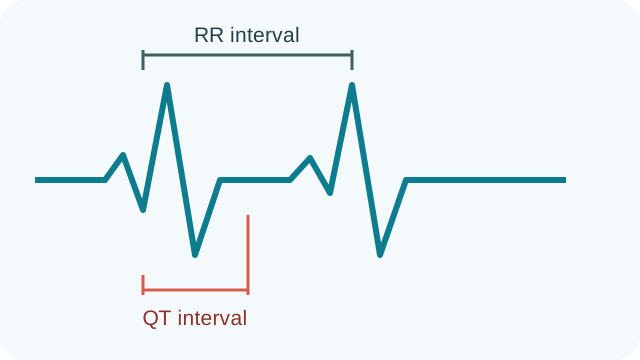
QT is measured on the ECG; RR is derived here from the entered heart rate.
The QT interval on an electrocardiogram covers ventricular depolarization and repolarization, and its measured length changes with heart rate. This calculator applies Bazett’s equation to estimate a heart-rate-corrected QT interval, written QTc. Enter heart rate in beats per minute and the measured QT in milliseconds; the result is returned in milliseconds.
Bazett correction is widely recognized, but it is only one correction method. An American Heart Association scientific statement notes that it can leave substantial error, especially at high heart rates, and recommends identifying the correction method used. QT measurement itself can be difficult when the T-wave end is unclear or the rhythm is irregular. The number here is educational and requires review in the full clinical context.
2
How to Use This Calculator
Enter a positive heart rate in beats per minute. Use the rate associated with the tracing from which the QT was measured.
Enter the measured QT interval in milliseconds. Check the ECG scale and measurement rather than entering a QTc value already reported by the machine.
Select Calculate. The page derives RR in seconds as 60 divided by heart rate, takes its square root and divides QT by that value.
Read the Bazett-corrected result, rounded to two decimal places and labeled ms. Record that Bazett’s method was used whenever you compare the result with a report or threshold.
The calculation assumes a reasonably representative heart rate and RR interval. Large beat-to-beat variation, an uncertain T-wave endpoint, wide QRS complexes and paced rhythms need specialist interpretation.
3
Formula Used
RR (seconds) = 60 ÷ heart rate
QTcB = QT ÷ √RR
QT is entered in milliseconds while RR is expressed in seconds, so the displayed QTc remains in milliseconds. Bazett’s square-root correction is the only method used by this page; Fridericia and other formulas can produce different values.
4
Variables Explained
Entry
Meaning
Unit or note
Heart rate
Ventricular rate associated with the measured interval
Beats per minute
QT
Measured interval from QRS onset to the end of the T wave
Milliseconds
RR
Time between successive ventricular beats used by the formula
Seconds, calculated as 60 divided by heart rate
QTcB
QT corrected with Bazett’s square-root formula
Milliseconds; the method must be named when reported
5
Worked Example
Suppose the heart rate is 75 beats per minute and the measured QT interval is 400 ms. First calculate RR: 60 ÷ 75 = 0.8 seconds. Its square root is approximately 0.894427. Apply Bazett’s equation: 400 ÷ 0.894427 = 447.2136 ms. The page returns 447.21 ms.
At exactly 60 beats per minute, RR equals 1 second and √RR also equals 1, so QTcB equals the measured QT. Away from 60, correction changes the value. This example demonstrates the arithmetic only. Whether 447.21 ms is clinically concerning depends on age, sex, tracing quality, QRS duration, medicines, electrolytes, symptoms, history and the standard used by the treating service.
6
Why Use This Calculator?
QTc is used to compare repolarization duration across heart rates, but it is not a stand-alone diagnosis or a direct prediction that an arrhythmia will occur. Clinicians inspect the tracing, confirm the QT endpoint, review medicines and electrolyte results, and consider symptoms and personal or family history. Computer-generated measurements should be visually checked when prolongation matters.
Bazett’s formula tends to perform poorly when heart rate is far from the usual range. Other corrections include Fridericia’s cube-root equation and regression-based methods; their results are not interchangeable with Bazett thresholds. Do not stop a prescribed medicine or change a dose from this result. Fainting, a seizure-like episode, sustained palpitations or collapse warrants urgent medical evaluation, especially when QT prolongation or a risky medicine is suspected.
7
Common Mistakes
Entering seconds in a field that expects QT milliseconds.
Entering a QTc copied from a report instead of the measured QT interval.
Pairing QT from one tracing with a heart rate from another time.
Treating the ECG machine’s QT endpoint as unquestionably correct.
Comparing a Bazett result with a limit developed for another correction method.
Ignoring irregular RR intervals, a wide QRS complex, pacing or an unclear T wave.
Using the value to change medicine without speaking with the prescribing clinician.
8
Frequently Asked Questions
What correction formula does this page use?
It uses Bazett’s formula, which divides measured QT by the square root of RR in seconds. The method matters because Fridericia and other corrections can return different numbers.
Should QT be entered in seconds or milliseconds?
Enter QT in milliseconds, as labeled. The page calculates RR in seconds internally. Entering 0.40 instead of 400 would make the result one thousand times too small.
Why can QTc differ from the ECG report?
The report may use another correction method, a different beat, or an automated QT measurement. Rounding and the selected RR interval also affect the result.
Is Bazett correction reliable at every heart rate?
No. Its error can grow at high or low rates. A clinician may prefer another method and should state which correction supports the interpretation.
Does a long QTc prove long QT syndrome?
No. Measurement error, medicines, electrolyte disturbance, illness and conduction changes can affect QTc. Diagnosis requires clinical review, repeat evidence when appropriate and relevant history.
Can I use this value to decide whether to stop medicine?
No. Stopping some medicines suddenly can cause harm. Discuss the ECG, symptoms, other drugs and laboratory results promptly with the prescriber or treating clinician.
When is urgent assessment appropriate?
Urgent assessment is appropriate for collapse, fainting, sustained palpitations, seizure-like events or severe symptoms, particularly with known QT prolongation or exposure to a QT-prolonging substance.