Mathematics calculator

Elimination Method Calculator

Solve two linear equations by combining their coefficients and verify the resulting unique intersection.

Calculator inputs

Enter your values

Two-equation system
Enter each equation as ax + by = c
Equation 1
Equation 2
Calculated output

Result summary

Your result will appear here

Complete the required fields and select the calculate button.

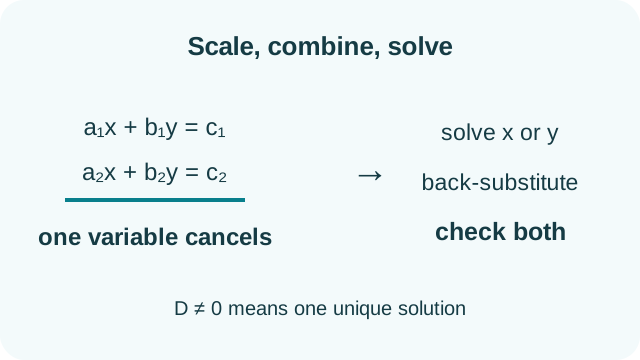
Two linear equations combined so one variable cancels before finding the intersection
Elimination scales and combines equations until one variable cancels, then back-substitutes for the other.
1

What is Elimination Method?

The elimination method solves two linear equations that share the unknowns x and y. Each equation represents a straight line. When the lines cross once, the calculator returns the coordinates of that intersection to the requested number of decimal places.

The six coefficient fields represent a1x + b1y = c1 and a2x + b2y = c2. Decimal and negative coefficients are allowed. The page also detects equations that do not determine one unique point, which covers parallel lines and two forms of the same line.

2

How to Use This Calculator

  1. Rewrite both equations in standard form, with x and y terms on the left and the constant on the right. Preserve every negative sign when moving a term.
  2. Enter a1, b1 and c1 for the first equation, then a2, b2 and c2 for the second.
  3. Choose a display precision from zero through ten decimal places. This controls rounding of the answers, not the accuracy of the supplied coefficients.
  4. Select Calculate. The coefficients are combined so one variable is eliminated, then both unknowns are obtained from the determinant relationships.
  5. Substitute the displayed x and y into both original equations. Small differences can occur when the displayed answers have been rounded.
3

Formula Used

For a1x + b1y = c1 and a2x + b2y = c2, define D = a1b2 − a2b1, Dx = c1b2 − c2b1, and Dy = a1c2 − a2c1.

When D is not zero, x = Dx/D and y = Dy/D. These determinant formulas produce the same solution as multiplying equations and adding or subtracting them to cancel a variable. When D is zero, division is impossible because the two lines have either no intersection or infinitely many shared points.

4

Variables Explained

InputMeaning and use
a1Coefficient of x in the first equation.
b1Coefficient of y in the first equation.
c1Constant on the right side of the first equation.
a2Coefficient of x in the second equation.
b2Coefficient of y in the second equation.
c2Constant on the right side of the second equation.
PrecisionNumber of decimal places displayed, from 0 through 10.
DCoefficient determinant; a nonzero value is required for one unique solution.
5

Worked Example

Solve 2x + y = 11 and x − y = 1. Enter a1 = 2, b1 = 1, c1 = 11, a2 = 1, b2 = −1 and c2 = 1. Here D = (2 × −1) − (1 × 1) = −3. Dx = (11 × −1) − (1 × 1) = −12, while Dy = (2 × 1) − (1 × 11) = −9.

Therefore x = −12/−3 = 4 and y = −9/−3 = 3. Substitution confirms both statements: 2(4) + 3 = 11 and 4 − 3 = 1. With precision 2, the page displays x = 4 and y = 3 because trailing zeroes are not added.

6

Why Use This Calculator?

The pair (x, y) is the single point that satisfies both equations. Geometrically, it is where the two lines cross. In an applied problem, attach the original meanings and units again only after confirming that the equations were modeled on a consistent basis.

A message saying there is no unique solution does not distinguish parallel lines from identical lines. Check whether all three coefficients of one equation are the same multiple of the other. If the left-side coefficients are proportional but the constants are not, the lines are parallel; if the constants share the proportion too, every point on the line satisfies both. A very small nonzero determinant can also make the numerical answer sensitive to tiny coefficient changes, so keep the source precision and verify by substitution. In an applied model, that sensitivity may matter more than the rounded coordinates themselves. Recheck how the equations were formed before reporting a precise answer.

7

Common Mistakes

  • Entering an equation before moving all variable terms to the left and the constant to the right.
  • Losing a minus sign when a term crosses the equals sign.
  • Putting c in a coefficient field or swapping the x and y coefficients in one row.
  • Expecting precision to repair uncertain input values. It only changes final display rounding.
  • Dividing during manual elimination too early and creating avoidable fractions or rounding error.
  • Assuming every pair of equations has exactly one solution.
8

Frequently Asked Questions

What equations can I enter?

Enter two equations that can be written as a1x + b1y = c1 and a2x + b2y = c2. Products such as xy, powers and denominators containing variables are not linear.

Why does the page say there is no unique solution?

The coefficient determinant is zero. The lines are either parallel with no shared point or are the same line with infinitely many shared points.

How can I tell parallel and identical equations apart?

Compare coefficient ratios. If a, b and c all have the same ratio, the equations describe one line; if only a and b share it, the lines are distinct and parallel.

Can I use decimal coefficients?

Yes. Each coefficient field accepts decimals and negative numbers. Keep enough meaningful digits to avoid changing the system through early rounding.

What precision should I choose?

Use enough decimals for the purpose and quality of the inputs. Two to four places often suit a numerical check, while exact classroom answers may be better kept as fractions manually.

Why does substitution differ slightly?

The displayed x and y may be rounded. Substitute with more internal precision or allow for a small rounding difference, especially when the determinant is close to zero.

Does elimination always require determinants?

No. Traditional elimination multiplies and combines equations directly. The determinant calculation used here is an equivalent compact route to the same unique solution.

9

Sources & References