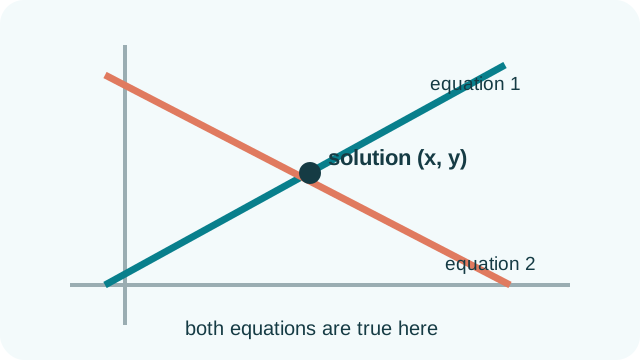
The answer is an ordered pair, so the positions of x and y matter. Geometrically it is the intersection of two lines. Algebraically it is the pair that makes both equalities true at once.
If D is zero, the coefficient rows are proportional. The lines are either distinct and parallel, giving no solution, or they describe the same line, giving infinitely many solutions. The constants decide which case applies, but neither case has one pair for this form to report.
Display precision changes rounding only. When coefficients are measured values or close to proportional, the solution can be sensitive to small input changes. Keep full source precision, then round the final pair appropriately.
Fractions must be entered as decimal values because the fields accept numbers. A repeating decimal is an approximation, so a hand solution with exact fractions may be preferable when exact form matters.
Standardizing the equations is often the hardest part. Moving a term across the equals sign changes its sign. For 2x = 7 − 3y, the standard form is 2x + 3y = 7.
A successful check uses the original equations, not rearranged copies that may contain the same transcription error. Evaluate each left side with the unrounded result where possible and compare it with its constant.
Scaling an entire equation by any nonzero number does not change its line or its solution set. This is a useful check: doubling all three values in one row should leave the final x and y unchanged. Scaling only one coefficient changes the equation and generally changes the answer.