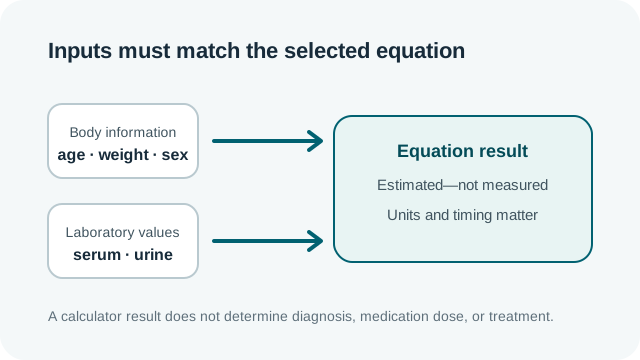
Calculate fractional excretion of sodium from paired serum and urine sodium and creatinine values.
Paired laboratory values
Enter serum and urine measurements
FENa
Renal calculation
Calculated fractional excretion
The FENa result will appear here
Use paired serum and urine samples and keep both creatinine values in the same unit.
Fractional excretion of sodium(urine Na × serum Cr) ÷ (serum Na × urine Cr) × 100
FENa
0%
Context note
—
Educational estimate only—not medical advice, a diagnosis, or a treatment instruction. FENa can be misleading with diuretics, chronic kidney disease, glomerular disease, obstruction, and several other conditions. It cannot identify the cause of kidney injury by itself.
Serum and urine values should be collected close together; creatinine units must match so they cancel in the ratio.
What is Fractional Excretion of Sodium?
Fractional excretion of sodium (FENa) is a calculated percentage that compares sodium and creatinine concentrations in a spot urine sample with concentrations in blood. Clinicians sometimes use it as one piece of an acute kidney injury assessment. It describes the fraction of filtered sodium appearing in urine at the sampling time; it does not identify a diagnosis by itself.
The four laboratory values should be obtained at roughly the same time. Clinical history, fluid status, urine output, medicines, baseline kidney function, urinalysis, imaging, and the trend in results can all change the interpretation. This educational calculator cannot determine the cause of kidney dysfunction or replace prompt assessment by a qualified healthcare professional.
How to Use This Calculator
Enter serum sodium and urine sodium using matching concentration units, usually mEq/L or mmol/L.
Enter serum creatinine and urine creatinine using matching creatinine units, such as mg/dL for both. The numeric units within each pair must match.
Select Calculate. The cross-product of urine sodium and serum creatinine is divided by the cross-product of serum sodium and urine creatinine, then multiplied by 100.
Review the percentage alongside the sampling circumstances and the person’s complete clinical picture. Do not use the category text as a stand-alone diagnosis.
Using matched units makes the concentration units cancel. A lab report copied from different systems may use serum creatinine in µmol/L and urine creatinine in mg/dL; those values must be converted to a common creatinine unit before entry.
Formula Used
FENa (%) = (UNa × PCr) ÷ (PNa × UCr) × 100
U means urine and P means plasma or serum. This is a ratio of ratios. All entered concentrations must be positive except urine sodium may be zero. A zero or negative denominator has no valid clinical meaning and is rejected.
Variables Explained
Inputs used in the calculation
Symbol or input
Meaning
Practical note
PNa — serum sodium
Sodium concentration in serum or plasma.
Use the laboratory value from the same assessment period.
PCr — serum creatinine
Creatinine concentration in serum or plasma.
Its unit must match urine creatinine.
UNa — urine sodium
Sodium concentration in a spot urine specimen.
Its unit must match serum sodium.
UCr — urine creatinine
Creatinine concentration in the urine specimen.
Do not substitute a timed total excretion amount.
FENa
Calculated fractional sodium excretion.
Reported as a percentage, not a probability or kidney function percentage.
Worked Example
Suppose the paired results are serum sodium 140 mEq/L, serum creatinine 2 mg/dL, urine sodium 35 mEq/L, and urine creatinine 100 mg/dL:
Numerator = 35 × 2 = 70.
Denominator = 140 × 100 = 14,000.
Ratio = 70 ÷ 14,000 = 0.005.
Percentage = 0.005 × 100 = 0.50%.
The arithmetic can be checked, but 0.50% alone does not establish why kidney function changed. Sampling time, treatment already given, and conditions that alter sodium handling must be considered.
Why Use This Calculator?
Traditional teaching often associates a value below 1% with sodium-avid physiology and a value above 2% with impaired tubular sodium reabsorption, leaving 1–2% less specific. These are contextual guideposts rather than diagnostic borders. Published reviews describe important overlap, and diagnostic performance varies with patient population and study design.
Diuretic exposure can raise urine sodium and weaken the usual interpretation. Chronic kidney disease, glomerular disease, obstruction, sepsis, contrast exposure, pigment injury, and early or mixed processes can also produce results outside a simple pattern. In newborns and some other populations, different thresholds may be discussed. A clinician should integrate the result with examination, serial creatinine measurements, urine microscopy, and other relevant tests.
Common Mistakes
Mixing creatinine units: serum µmol/L and urine mg/dL do not cancel; convert one before calculating.
Using samples from different times: fluids, medicines, and changing kidney function can make an unmatched pair misleading.
Reading a threshold as a diagnosis: FENa has overlap between causes and cannot confirm acute tubular injury or volume depletion.
Ignoring diuretics: they alter renal sodium handling and can raise the result.
Confusing a concentration with a timed amount: enter the concentration reported for the spot sample.
Delaying care: reduced urine, swelling, confusion, severe weakness, breathing difficulty, or rapidly worsening illness needs prompt medical attention.
Frequently Asked Questions
What does a low FENa mean?
It can reflect avid sodium retention, which may occur with reduced kidney perfusion, but it is not specific. Timing, medicines, chronic disease, and several intrinsic kidney processes can also yield a low result.
Can FENa diagnose acute tubular necrosis?
No. It may contribute to a clinician’s differential assessment, but no cutoff confirms acute tubular injury. History, trends, urine findings, and the full clinical setting remain necessary.
Do diuretics affect the calculation?
They do not change the arithmetic formula, but they can increase urinary sodium and make the traditional interpretation less reliable. Tell the treating clinician which medicines and doses were recently used.
Must the blood and urine samples be collected together?
They should be collected as close together as practical because concentrations and kidney handling can change over time, especially during fluid therapy or evolving illness.
Can I mix mmol/L and mEq/L for sodium?
For sodium, the numerical values of mmol/L and mEq/L are equivalent because sodium is monovalent. The serum and urine creatinine figures still need the same creatinine unit.
Is FENa the same as kidney function?
No. It describes fractional sodium excretion at a point in time. It is not an estimated filtration rate, a percentage of functioning kidney, or a measure of permanent damage.
When should I seek medical help?
Contact a healthcare professional promptly for a new abnormal kidney result or marked change in urine output. Emergency symptoms such as breathing difficulty, confusion, fainting, or severe illness require urgent care.