The Absolute Lymphocyte Count Calculator combines WBC in thousands per microlitre with lymphocyte percentage. It returns ALC in cells/µL, without diagnosing a condition or selecting an age-specific reference range.
CBC values
Enter WBC and lymphocyte percentage
ALC
Laboratory summary
Absolute count
The absolute count will appear here
Enter WBC in thousands per microlitre and lymphocytes as a percentage.
Absolute lymphocyte count WBC × 1,000 × lymphocyte percentage/100, in cells/µL. It is a total lymphocyte concentration, not a CD4 count or a diagnosis.ALC = WBC × 1,000 × lymphocyte % ÷ 100
Absolute lymphocyte count The same ALC as the featured result, displayed to at most two decimals.
0 cells/µL
WBC entered The WBC number entered, repeated in ×10³/µL. It is not the value multiplied by 1,000.
0 ×10³/µL
Lymphocyte fraction Despite the fraction label, this card repeats the entered percentage, for example 35%, rather than 0.35.
0%
Educational estimate only. It is not medical advice, a diagnosis, or a substitute for assessment by a qualified healthcare professional. Reference ranges differ with age, laboratory, health status, and clinical setting.
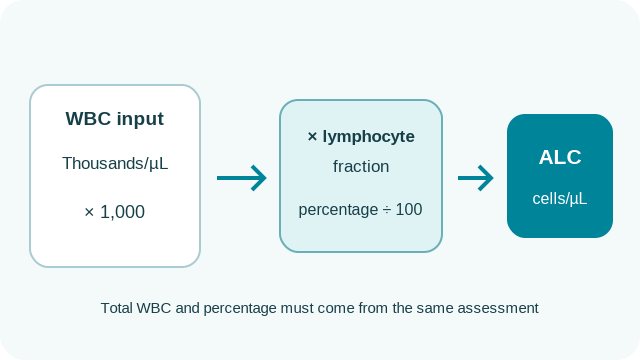
The fixed diagram shows WBC scaling and percentage multiplication, not a microscope image or a clinical assessment.
What Is Absolute Lymphocyte Count (ALC)?
Use this lymphocyte count calculator to find ALC from WBC and lymphocyte percentage. Enter WBC in thousands per microlitre to get cells per microlitre.
Absolute lymphocyte count, or ALC, estimates how many lymphocytes are present in a volume of blood. A lymphocyte percentage gives their share of all white blood cells; the absolute count combines that share with the total white blood cell count.
MedlinePlus describes the white blood cell differential. This page performs the percentage calculation from existing laboratory results. It does not identify cell subtypes, diagnose an infection or measure how well the immune system works.
How to Calculate Absolute Lymphocyte Count
Enter both values from the same blood-count assessment and press Calculate ALC. The WBC unit is part of the calculation, not a decorative label.
White blood cells (10³/µL). Enter the count in thousands per microlitre. For 7,200 cells/µL, enter 7.2, not 7,200.
Lymphocytes (%). Enter the relative percentage, such as 35 for 35%, not 0.35. Values from zero through 100 are accepted.
Read Absolute lymphocyte count. The main result and detailed ALC show the same count in cells/µL.
Check WBC entered and Lymphocyte fraction. These repeat your entries for checking. Despite its fraction label, that card displays the percentage with a % sign.
WBC must be zero or positive. The form has no alternate-unit selector and does not enter age or a laboratory reference interval. The info icons explain the required units while you work.
If the report already gives an absolute lymphocyte result, compare its units and precision before expecting an exact match. Do not use a white cell count from one report with a differential percentage from another.
Absolute Lymphocyte Count Formula
The WBC input is in thousands of cells per microlitre. Multiply by 1,000 to obtain cells/µL, then multiply by the lymphocyte fraction.
For a WBC entry of 7.2 and lymphocytes 35%, the steps are 7.2 × 1,000 = 7,200 cells/µL, and 35 ÷ 100 = 0.35.
example ALC = 7,200 × 0.35 = 2,520 cells/µL
The calculation returns the numerical result without an explicit rounding step. The interface formats ALC to at most two decimal places and may omit trailing zeros. A whole number is shown when no fractional display is needed.
An absolute count here is a concentration of cells in a blood volume, not the total number of lymphocytes in the entire body. It is also different from the relative lymphocyte percentage.
Lymphocyte Count Inputs and Results
White blood cells
Total WBC in 10³/µL, meaning thousands per microlitre. The calculator multiplies this entry by 1,000.
Lymphocytes
The reported percentage of white blood cells identified as lymphocytes, entered from 0 to 100.
Absolute lymphocyte count
The calculated concentration in cells/µL. The featured result and ALC detail show the same value.
WBC entered
The original WBC number repeated in ×10³/µL, not the multiplied cells/µL value.
Lymphocyte fraction
This result label repeats the supplied percentage with a % sign. It does not show a decimal fraction such as 0.35.
cells/µL
Cells per microlitre. A microlitre and a cubic millimetre describe the same volume for this count convention.
Lymphocyte Worked Example
Illustrative example. Suppose one report gives WBC 7.2 ×10³/µL and lymphocytes 35%.
Convert WBC: 7.2 × 1,000 = 7,200 cells/µL.
Convert percentage to fraction: 35 ÷ 100 = 0.35.
Multiply: 7,200 × 0.35 = 2,520 cells/µL.
The calculator displays 2,520 cells/µL. WBC entered remains 7.2 ×10³/µL, and Lymphocyte fraction shows 35%.
Hypothetical ALC examples using the required WBC input unit
WBC (10³/µL) / lymphocytes
ALC, cells/µL
7.2 / 35%
2,520
3.2 / 35%
1,120
9.6 / 18%
1,728
The first two rows have the same lymphocyte percentage but different absolute counts because total WBC differs. The third row shows why a lower percentage does not necessarily mean a lower absolute result than every other example.
Calculation check. We independently checked the unit scaling, percentage fractions and products, then compared all three hypothetical rows with the calculator results. The examples are not laboratory reference ranges or patient diagnoses.
Checking the Count Units
A WBC unit mistake can change the result by a factor of 1,000. This form expects WBC in thousands per microlitre and returns ALC in cells per microlitre.
Equivalent values for the illustrative 7.2 and 35% example
Quantity
Equivalent values
WBC input
7.2 ×10³/µL = 7.2 ×10⁹/L
WBC in individual cells
7,200 cells/µL
Lymphocyte proportion
35% = 0.35 as a fraction
ALC output
2,520 cells/µL = 2.52 ×10⁹/L
One litre contains one million microlitres. That is why 10⁹ cells/L and 10³ cells/µL have the same numerical value. A cubic millimetre is also one microlitre, so cells/mm³ and cells/µL are equivalent here.
These equalities explain units; they do not add a unit selector to the form. Enter the WBC value on the scale shown by its label, and keep the output unit attached when comparing the result with a report.
Reading the Lymphocyte Count
Read ALC as a concentration calculated from the supplied WBC and percentage. It does not identify why a count is high or low, and the page assigns no clinical category.
NHLBI also describes additional testing to identify different lymphocyte populations. This form has no separate T-cell, B-cell, natural-killer-cell or CD4 input. A total ALC cannot be treated as a measured CD4 count or a diagnosis of immune deficiency.
The diagram shows total WBC multiplied by a lymphocyte fraction to produce an absolute count. It is a fixed explanation of the calculation, not a microscope image or an analysis of individual cells.
Use your laboratory’s range and the complete report with the responsible clinician. Rechecking an arithmetic result can help identify a unit mistake, but it cannot replace evaluation of symptoms, blood-cell findings or medical history.
Common ALC Mistakes
Entering cells/µL in a thousands field. For 7,200 cells/µL enter 7.2.
Entering 0.35 for 35%. The percentage field expects 35, not the decimal fraction.
Mixing different blood samples. WBC and lymphocyte percentage should belong to the same assessment.
Reading the repeated fraction card as a decimal. It shows a percentage.
Comparing unconverted output units. Cells/µL and ×10⁹/L use different numeric scales.
Using ALC to infer a cell subtype or diagnosis. The calculation does not identify CD4 cells or assess immune function.
Lymphocyte Count Questions
What is absolute lymphocyte count?
ALC is the estimated concentration of lymphocytes in blood. This calculator multiplies total WBC by the lymphocyte fraction and reports cells per microlitre.
Which WBC unit should I enter?
Thousands per microlitre, written 10³/µL. If a report gives 7,200 cells/µL, enter 7.2. A value reported as 7.2 ×10⁹/L is numerically equivalent to 7.2 ×10³/µL.
Should I enter 35 or 0.35 for 35% lymphocytes?
Enter 35. The calculator divides by 100 to form the fraction. Entering 0.35 means 0.35%, not 35%.
Why can the same percentage give different absolute counts?
The percentage is multiplied by total WBC. At 35%, a WBC entry of 7.2 gives 2,520 cells/µL, while 3.2 gives 1,120 cells/µL.
Can I use the number for a child?
The arithmetic can be performed from valid entries, but the form does not collect age or classify the result. A child’s report needs the appropriate age-specific laboratory interpretation.
Is ALC the same as CD4 count?
No. ALC includes lymphocytes as a whole, while CD4 is a particular cell measurement. This calculator cannot separate cell subtypes or infer a measured CD4 result.
Why does the Lymphocyte fraction card show a percent sign?
The label is used for a repeat of your percentage entry. It displays 35% for an input of 35, rather than showing the decimal fraction 0.35.
Can zero values be entered?
Yes. Zero WBC or zero lymphocyte percentage gives zero ALC in the calculation. Numeric acceptance is not a judgment that a zero result is clinically expected or safe.
NHLBI: Lymphopenia Diagnosis. Age/context-dependent interpretation and tests for lymphocyte subtypes. No diagnostic cutoff from this page is applied automatically.
Related Blood Count Tools
These tools answer different questions. Check their methods and inputs before comparing results:
Absolute Neutrophil Count. Calculate a different white cell count from neutrophil inputs. It is not interchangeable with ALC.
Reticulocyte Index. Review a red-cell production index using hematocrit and reticulocyte percentage rather than white cells.
Blood Type
. Explore possible child ABO/Rh labels from parental blood types, a separate inheritance calculation.
Blood Donor. Look up ABO/Rh compatibility for blood or plasma. This does not measure lymphocytes or establish donor eligibility.
Plasma Volume. Estimate plasma volume from body weight and hematocrit rather than counting white blood cells.