Mathematics calculator

Perfect Cube Calculator

Check whether a whole number is the cube of an integer and compare it with its real cube root.

Calculator inputs

Enter your values

Integer cubes
Calculated output

Result summary

Your result will appear here

Complete the required fields and select the calculate button.

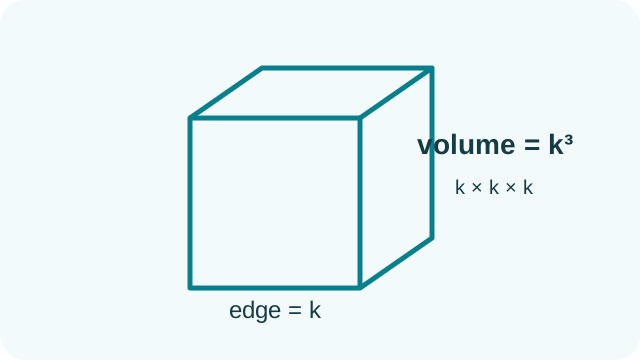
A cube with equal edge lengths and volume equal to the edge length cubed
A whole number is a perfect cube when it can be represented as k × k × k for an integer k.
1

What is Perfect Cube?

A perfect cube is an integer obtained by multiplying another integer by itself three times. The number 125 is a perfect cube because 5 × 5 × 5 = 125. A negative integer can also be a perfect cube: (−5) × (−5) × (−5) = −125.

This calculator checks a whole number and reports whether it is a perfect cube. It also shows the integer root candidate, that candidate cubed, and a decimal cube-root approximation for comparison. Decimal inputs are rejected instead of being silently changed into integers.

2

How to Use This Calculator

  1. Enter the whole number you want to test, including a minus sign if it is negative.
  2. Choose Calculate and read the perfect-cube verdict.
  3. Compare the integer root candidate with the decimal cube-root approximation.
  4. Check the candidate cubed. The number is a perfect cube only when this product exactly reproduces the input.

Use a whole number without commas or a decimal point. A value such as 125.9 is not an integer and the form will ask you to correct it.

3

Formula Used

n is a perfect cube if an integer k satisfies k³ = n. The check rounds a numerical cube-root estimate to k and tests k × k × k against the integer input.
4

Variables Explained

QuantityExplanation
nThe integer being classified. Both positive and negative whole numbers are valid mathematical candidates.
kAn integer root candidate. The actual test is whether cubing it reproduces n.
Perfect-cube verdictA statement about the integer test. A nearby integer root does not establish that n is a perfect cube.
5

Worked Example

For n = 216, the candidate root is 6. Cubing it gives 6 × 6 × 6 = 216, so the number is a perfect cube. For n = 217, the same nearby candidate has cube 216, not 217. The second number is therefore not a perfect cube.

A negative example

For n = −343, the root candidate is −7. Cubing −7 gives −343, so the verdict is yes. Negative perfect cubes are possible because multiplying three negative factors leaves a negative result.

Using volume to interpret the root

A cube with volume 512 cubic centimeters has edge length 8 centimeters because 8³ = 512. A volume of 500 cubic centimeters also defines a real edge length, but that edge is not a whole number. “Not a perfect cube” does not mean that no real cube root exists.

Checking a claim without relying on a rounded root

If someone suggests that 1,000 is a perfect cube with root 10, multiply 10 × 10 × 10 directly. For small integers, this exact product is clearer than deciding whether a printed decimal root looks close enough to an integer.

6

Why Use This Calculator?

Perfect-cube checks help with number patterns, exact integer problems and simplifying cube roots. If a cube-root expression contains a perfect-cube factor, that factor can be taken outside the radical: ∛(8 × 3) = 2∛3. The calculator classifies one integer at a time rather than carrying out a symbolic factorization.

Neighboring cubes give useful bounds

The sequence 0, 1, 8, 27, 64, 125 and 216 consists of the cubes of 0 through 6. The gaps grow as the roots increase. If 125 < n < 216, its positive cube root lies between 5 and 6, so there is no integer root in that open interval.

How the displayed checks relate

The decimal root is useful for seeing where the number lies between neighboring cubes. The verdict comes from cubing the nearby integer candidate and comparing that product with the original whole number. The form limits the accepted range so this integer check stays within dependable arithmetic.

7

Common Mistakes

  • Do not reject a number solely because it is negative. Negative odd powers are valid.
  • Do not confuse a cube with three times a number: 4³ = 64, while 3 × 4 = 12.
  • Do not enter a decimal when answering an integer perfect-cube question.
  • Verify by cubing the candidate rather than relying on how close a decimal root looks to an integer.
8

Frequently Asked Questions

Are zero and one perfect cubes?

Yes. Zero is 0³ and one is 1³. The number −1 is also a perfect cube because (−1)³ = −1. These values fit the same integer definition as larger examples.

Does “not a perfect cube” mean there is no cube root?

No. Every real number has a real cube root. The perfect-cube question asks whether that root is an integer. For instance, 2 has a real cube root but is not an integer perfect cube.

Why is the root field an integer for a non-cube?

The integer candidate is the nearby whole number used for the exact cube check. For a non-cube, use the separate approximate cube-root value to see the decimal result.

Can a number be both a perfect square and a perfect cube?

Yes. For example, 64 = 8² = 4³. More generally, a nonnegative integer raised to the sixth power is both a square and a cube.

9

Sources & References