Mathematics calculator

Perfect Square Calculator

Check whether a whole number is the square of an integer and compare it with its real square root.

Calculator inputs

Enter your values

Integer squares
Calculated output

Result summary

Your result will appear here

Complete the required fields and select the calculate button.

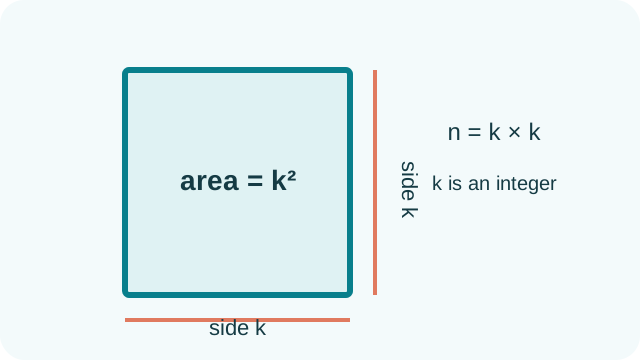
A square with equal side lengths k and area k squared
A nonnegative whole number is a perfect square when it equals k × k for an integer k.
1

What is Perfect Square?

A perfect square is a nonnegative integer that can be written as an integer multiplied by itself. For example, 144 = 12 × 12, so 144 is a perfect square. The number 145 is not: it lies between 12² = 144 and 13² = 169.

This page tests a whole number and displays the verdict, a nearby integer root, that candidate squared, and a decimal square-root approximation. Decimal inputs are rejected rather than silently changed into integers.

2

How to Use This Calculator

  1. Enter the whole number you want to classify.
  2. Choose Calculate and read whether the number is a perfect square.
  3. Compare the nearby integer root with the decimal approximation.
  4. Check the candidate squared. The verdict is positive only when that product exactly matches the input.

A negative integer cannot be a perfect square of a real integer. A decimal such as 144.9 is not a whole number, so the form asks you to correct it instead of testing 144.

3

Formula Used

n is a perfect square if an integer k satisfies k² = n. For n ≥ 0, the implementation rounds √n to an integer candidate k and checks k × k against n.
4

Variables Explained

QuantityExplanation
nThe integer being tested. The ordinary perfect-square definition requires n to be nonnegative.
kThe integer root candidate used in the test. For a non-square, it is not the exact square root.
VerdictWhether an integer squared reproduces n exactly within the implementation’s numeric range.
5

Worked Example

Enter 225. Its root candidate is 15, and 15 × 15 = 225, so the verdict is yes. Enter 226 and the nearby candidate remains 15, but 15² is 225 rather than 226. The second verdict is no.

Zero and one

Zero is a perfect square because 0² = 0. One is also a perfect square because 1² = 1. Their small size does not exclude them from the definition. The next positive examples are 4, 9, 16, 25, 36 and 49.

A geometric interpretation

If 196 identical tiles can be arranged as a 14-by-14 square with no tiles left over, their count is a perfect square. A count of 197 cannot form such an integer-sided arrangement without leaving a tile or changing the shape. This interpretation concerns counts of tiles, not their physical area unless the tile sizes are also known.

Ruling out a value by neighboring squares

Because 20² = 400 and 21² = 441, every integer strictly between 400 and 441 is not a perfect square. You do not need a long decimal root to prove that 420 is not a square.

6

Why Use This Calculator?

Perfect-square checks are useful in exact arithmetic, simplifying radicals, looking for integer solutions and studying numerical patterns. When a radical contains a perfect-square factor, that factor can be extracted: √(9 × 5) = 3√5.

One value, two signed integer roots

A positive square such as 81 can be written as 9² or (−9)². The classifier uses the nonnegative root candidate, but this does not erase the negative solution of an equation like x² = 81. Distinguish the principal root √81 = 9 from the two solutions x = ±9.

Numeric limits and integer conversion

The code uses ordinary server integers and a floating-point square-root estimate. It is appropriate for modest whole-number examples. Very large inputs may exceed the platform’s integer range or lose precision during conversion, so do not use the displayed verdict as a proof for arbitrarily large integers. Exact big-integer algorithms are preferable when every digit matters.

The word integer also matters. A decimal can be the square of a rational number, such as 0.25 = 0.5², without being a perfect-square integer under the definition this page tests.

7

Common Mistakes

  • Do not enter a fraction or decimal and assume this integer classifier will preserve it unchanged.
  • Do not read a rounded root candidate as an exact root when the verdict is no.
  • Do not confuse doubling with squaring: 8 × 2 is 16, while 8² is 64.
  • A final digit can rule out some squares, but a plausible final digit cannot prove a number is a square. For example, 21 ends in 1 but is not a perfect square.
8

Frequently Asked Questions

Can a negative integer be a perfect square?

No. Squaring any real integer produces a nonnegative number. Negative numbers can have complex square roots, but that is different from being the square of an integer.

Why does the root candidate look rounded?

The implementation tests the nearby integer obtained from the numerical square root. The exact multiplication check determines the verdict. Use another tool if you need the noninteger square root of a non-square.

Is every number ending in 00 a perfect square?

No. While 100 and 400 are perfect squares, 200 and 300 are not. A suffix alone does not establish the existence of an integer root.

How can I check a positive answer manually?

Square the suggested integer root. If the product exactly matches the input, you have an explicit integer factorization n = k². This is a direct check that avoids relying on rounded decimal notation.

9

Sources & References