Hollow pipe mass

Pipe Weight Calculator

Estimate the material volume and weight of a round pipe from its diameters, length, and material density.

Pipe details

Enter dimensions and material

Weight
Material summary

Your estimate

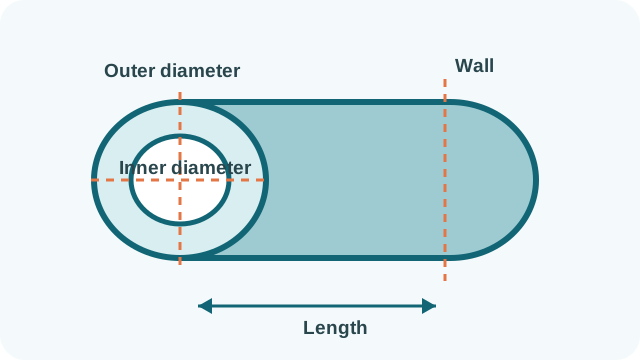
Hollow round pipe showing outer diameter, inner diameter, wall thickness, and length
Only the material between the outer and inner diameters contributes to pipe weight.

Your pipe weight will appear here

Enter the finished pipe dimensions and select its material.

What is Pipe Weight?

This calculator estimates the material volume and mass of a straight hollow round pipe. It uses outer diameter, inner diameter, length and a selected material density. Mixed dimension units are accepted because each measurement is converted to metres before the cross-sectional calculation.

The output is useful for early lifting, shipping or quantity estimates, but it is not a certified load figure. Actual products can include seams, coatings, couplings and manufacturing tolerances. Confirm supplier mass data and obtain appropriate engineering review when safety depends on the value.

How to Use This Calculator

  1. Select the pipe material. Each menu choice supplies a nominal density in grams per cubic centimetre.
  2. Enter the outside diameter, inside diameter and length, choosing the correct unit beside each value.
  3. Check that the inner diameter is smaller than the outer diameter, then select Calculate.

The page converts all dimensions to metres. It subtracts the inner circular area from the outer circular area and multiplies by length. Cubic metres are converted to cubic centimetres with a factor of one million. Material density is converted to kilograms per cubic metre by multiplying the selected value by 1,000, then volume and density are multiplied to obtain kilograms.

Formula Used

Material volume V = πL(Do² − Di²)/4. Mass m = Vρ. Dimensions are expressed in metres for V in m³; 1 m³ = 1,000,000 cm³. The selected density in g/cm³ is numerically multiplied by 1,000 to obtain kg/m³.

Variables Explained

InputMeaningRequirement
MaterialMenu value supplying nominal densityMatch the actual grade when possible
Outer diameter (Do)Full outside width through the centrePositive measurement
Inner diameter (Di)Open bore through the centreZero or greater and less than Do
Length (L)Length of the uniform pipe sectionPositive measurement
MassEstimated amount of pipe materialDisplayed in kilograms

An inner diameter of zero models a solid round bar. For an actual hollow pipe, enter the measured bore.

Worked Example

Choose carbon steel at 7.84 g/cm³ and enter an outer diameter of 10 cm, inner diameter of 8 cm and length of 1 m. In metres, the diameters are 0.10 and 0.08. Material volume is π × 1 × (0.10² − 0.08²) ÷ 4 = 0.00282743 m³, or 2,827.43 cm³.

The density converts to 7,840 kg/m³. Multiplying it by the unrounded cubic-metre volume gives about 22.17 kg. The displayed volume describes pipe material, not the open space inside the bore.

Why Use This Calculator?

The result is an estimated mass for the uniform length entered. It excludes the contents of the pipe and any extra parts. To estimate a filled assembly, calculate the fluid mass from the internal volume, then add it to pipe and component masses with suitable allowances.

Density varies among grades and alloys. The labels in the menu are broad reference choices rather than material certificates. Thin walls also make the result sensitive to diameter tolerances because mass depends on the difference between two squared values.

For multiple identical lengths, multiply the unrounded single-length mass by the quantity before rounding. For different sizes, calculate each line item separately. This preserves the effect of each wall thickness and material selection instead of relying on one average section.

Common Mistakes

Do not reverse the inner and outer diameters; the page rejects an inner diameter that is equal to or larger than the outside diameter after unit conversion. Check mixed units carefully—a 100 mm outer diameter and 8 cm inner diameter are valid even though their raw numbers look reversed.

A previous scale error would result from treating one cubic metre as ten million cubic centimetres; the correct factor is one million. Also avoid reading kilograms as force, assuming coatings have no mass, or using nominal size in place of actual diameters.

Check whether a supplier lists nominal or actual dimensions and whether its published mass already includes a manufacturing convention. Comparing like-for-like inputs is more useful than forcing a theoretical estimate to match a catalog number by changing density without evidence.

Frequently Asked Questions

Does volume mean the space inside the pipe?

No. On this page, volume is the solid material between the outer and inner surfaces. Internal capacity is a separate cylinder calculation.

Can I enter different units for each dimension?

Yes. Each diameter and the length are converted independently, so a millimetre outer diameter can be paired with a centimetre bore.

Why must inner diameter be smaller?

A hollow round section needs material between its inner and outer surfaces. An equal or larger bore would give zero or negative material area.

Can this calculator model a solid bar?

Yes. Enter an inner diameter of zero. The annular-area formula then reduces to the area of a solid circle.

Does the estimate include paint or fittings?

No. It covers only a uniform section at the selected nominal density. Add coatings, flanges, couplings and other parts separately.

Why can a catalog weight differ?

Actual grade density, dimensional tolerance, seams and product standards can shift mass. Prefer manufacturer data for purchasing or lifting plans.

Is kilogram a weight or a mass here?

The calculation returns mass in kilograms. Weight as force would be expressed in newtons and depends on local gravitational acceleration.

Sources & References