Liquid capacity

Pipe Volume Calculator

Estimate a pipe’s internal capacity and the weight of the liquid it contains.

Internal dimensions

Enter pipe and liquid details

Capacity
Capacity summary

Pipe contents

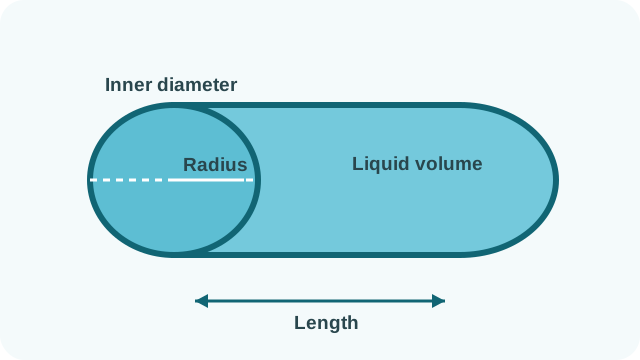
Pipe capacity diagram showing internal diameter, radius, length, and liquid-filled interior
Capacity uses the internal diameter—not the pipe’s outside diameter.

Your pipe capacity will appear here

Enter the pipe’s inside diameter, length, and liquid density.

What is Pipe Volume?

This calculator estimates the internal capacity of a straight, round pipe and the mass of liquid that would occupy that space. Enter the pipe’s internal diameter, its length and the liquid density. The page converts the dimensions to metres before applying the cylinder formula.

The result is a geometric estimate for a completely full, uniform pipe. Real usable capacity can differ because of fittings, valves, slope, deposits, manufacturing tolerances or trapped air. For purchasing, safety or process design, use verified dimensions and the requirements that apply to the system.

How to Use This Calculator

  1. Measure the pipe length and choose centimetres, metres, feet or inches.
  2. Enter the inner diameter, not the outside or nominal trade size, and choose its unit independently.
  3. Enter liquid density in kilograms per cubic metre, then select Calculate.

The page converts both dimensions to metres. It divides diameter by two to obtain radius, then calculates the volume of a cylinder. Cubic metres are multiplied by 1,000 for litres. Liquid mass is found by multiplying cubic metres by density.

The density unit shown by the form is kilograms per cubic metre. The selector does not perform density conversions, so convert another density unit before entry.

Formula Used

Internal volume V = π(d/2)²L = πd²L/4. Litres = V × 1,000. Liquid mass in kilograms = V × ρ, where dimensions are converted to metres and density ρ is in kg/m³.

Variables Explained

Input or outputMeaningUnit basis
Length (L)End-to-end length of the uniform sectionConverted to metres
Inner diameter (d)Clear bore measured across the centreConverted to metres
Density (ρ)Mass per unit volume of the liquidkg/m³
VolumeIdeal cylindrical internal spacem³ and litres
Liquid weightNumerically a mass estimatekilograms

The output label says weight, but multiplying volume by kg/m³ produces kilograms of mass. Force in newtons would additionally require gravitational acceleration.

Worked Example

Take a pipe with an inner diameter of 10 centimetres and a length of 10 metres. Convert the diameter to 0.1 metre, giving a radius of 0.05 metre. The volume is π × 0.05² × 10 = 0.0785398 cubic metre, displayed as 0.0785 m³ or 78.54 litres.

For water represented by a density of 1,000 kg/m³, the estimated contained mass is 0.0785398 × 1,000 = 78.54 kilograms. If the pipe is only half full, this page’s full-cylinder answer must be adjusted; the simple calculator does not ask for fill depth.

Why Use This Calculator?

Capacity changes with the square of diameter. A small diameter measurement error can therefore matter more than the same percentage error in length. Use the actual internal bore from a reliable specification or measurement. Nominal pipe size often does not equal the measured inner diameter.

Density varies with material, temperature, concentration and sometimes pressure. The calculated mass is only as reliable as the density supplied. The estimate also excludes the pipe wall itself; use a pipe-weight calculation when the mass of the material is needed.

If several pipe sections have different bores, calculate each uniform section separately and add their volumes. One average diameter can be misleading because diameter is squared. Apply the same approach to branches rather than treating the entire network as one straight cylinder.

Common Mistakes

Using outer diameter is the most common source of an overstated capacity. Other errors include mixing centimetres and metres, entering density in grams per cubic centimetre without converting it, and reading litres as cubic metres.

Do not assume every section is a perfect unobstructed cylinder. Subtract or separately account for internal equipment and fittings where they materially affect volume. Keep intermediate values unrounded, especially the converted diameter, because the formula squares it.

Be clear about what “full” means in the job at hand. A pipe may need vapor space, flushing allowance or drainage that prevents its entire ideal volume from being usable. Those operating allowances belong after the geometric calculation and should come from the relevant design requirements.

Frequently Asked Questions

Should I enter inner or outer diameter?

Use the inner diameter, also called the bore, because this calculation concerns the space available to hold liquid.

Why does diameter affect capacity so strongly?

The formula contains diameter squared. Doubling the bore while keeping length fixed makes the ideal internal volume four times as large.

What density should I enter for water?

A rounded value near 1,000 kg/m³ is often used for estimates, but water density changes with temperature. Use a value suited to the required precision.

Does the liquid-weight result include the pipe?

No. It estimates the mass of the full liquid contents. Pipe wall mass requires outer diameter, inner diameter and material density.

Can this calculate a partly filled horizontal pipe?

No. It assumes the circular cross-section is completely full. A partly filled horizontal pipe needs a circular-segment calculation based on fill depth.

Are fittings and valves included?

No. The result represents a straight uniform cylinder. Add or subtract component volumes separately when they are significant.

Why might measured capacity be lower?

Wall deposits, dimensional tolerances, air pockets and internal components can reduce usable space compared with the ideal geometric estimate.

Sources & References