Swimming pool capacity

Pool Volume Calculator

Estimate water volume for a rectangular or oval pool with a flat or sloping floor.

Pool measurements

Enter the inside dimensions

Water
Water summary

Pool capacity

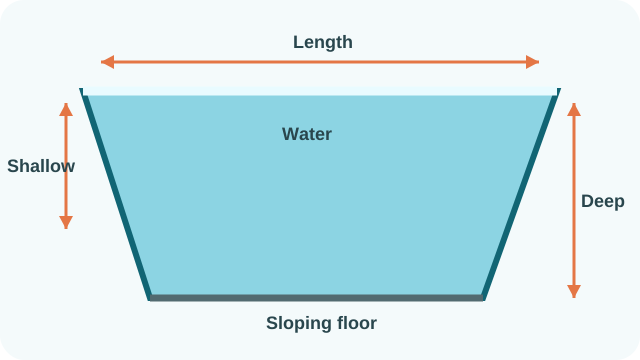
Swimming pool diagram showing length, width, shallow depth, deep depth, and sloping floor
Average depth accounts for a steady slope between the shallow and deep ends.

Your pool volume will appear here

Select the shape and enter the internal water dimensions.

1

What is Pipe Volume?

The pool calculator estimates how many litres a rectangular or oval pool can hold from its inside length, width and two depth measurements. It is useful for an early water-volume estimate before choosing pump flow, comparing treatment instructions or planning how much water a fill may require.

Real pools often include steps, benches, curved walls and a sloped floor, so a tape-measure estimate will not exactly match a meter reading. The page uses an average of the two depths and treats the rest of the selected shape as regular.

Before measuring, decide whether you need maximum design capacity or the amount at the normal water line. Use the same boundary for length, width and depth. For a partly filled pool, measure depth to the present surface. For a planning capacity, measure to the intended operating level. Write the measurements down as you go; it is easy to swap a shallow-end depth in feet with a metric value from another tool.

2

How to Use This Calculator

  1. Select Rectangle or Oval.
  2. Enter the internal length and width, choosing the unit beside each value.
  3. Measure a depth at each end and choose its unit. The page converts every dimension to metres.
  4. Select Calculate. It averages the depths, calculates cubic metres, then multiplies by 1,000 to display litres.

Mixed units are allowed, which is helpful when an old pool plan lists feet but a depth measurement was taken in metres. Check each menu rather than assuming one unit selection applies to the complete form.

3

Formula Used

Average depth = (depth 1 + depth 2) ÷ 2.

Rectangle: volume = length × width × average depth.

Oval: volume = π × (length ÷ 2) × (width ÷ 2) × average depth.

All dimensions are converted to metres first. Cubic metres are multiplied by 1,000 to obtain litres. The oval formula models the surface as an ellipse with straight vertical sides.

4

Variables Explained

Input or valueMeaning
Pool shapeRectangle uses length times width; Oval uses the area of an ellipse.
LengthThe longest internal water dimension, converted to metres.
WidthThe internal crosswise water dimension at the representative widest section, converted to metres.
Depth 1 and depth 2Water depths used to make one arithmetic mean. They may describe shallow and deep ends.
LitresEstimated water capacity. One cubic metre equals 1,000 litres.
5

Worked Example

Take a rectangular pool that is 10 m long, 4 m wide, 1 m deep at one end and 2 m deep at the other. Its average depth is:

(1 + 2) ÷ 2 = 1.5 m.

The volume is 10 × 4 × 1.5 = 60 cubic metres. Multiplying by 1,000 gives 60,000 litres, which is the displayed result. An oval pool with the same dimensions would be π × 5 × 2 × 1.5 = 47.12 cubic metres, or about 47,123.89 litres.

6

Why Use This Calculator?

The answer is a geometric estimate of capacity up to the dimensions you entered. If length and width were measured at the coping but the water surface is smaller, the estimate will be high. If the pool is not filled to the measured depth, the current water amount will also be lower.

For chemical treatment, use the concentration and safety directions supplied with the product and refine the volume using fill records or water-meter readings when available. Small measurement errors multiply across three dimensions, so apparent precision to the last litre should not be treated as actual accuracy.

For a pool with several distinct sections, calculate each section separately and add the litre totals. This takes longer, but it usually describes an L-shaped pool or a separate deep well better than one large rectangle. The page itself returns one regular-shape estimate per calculation.

7

Common Mistakes

  • Measure the water space inside the pool, rather than the outside of the shell.
  • Do not enter a sloping depth as though the entire pool had that depth; use representative end depths.
  • Select Oval only when an ellipse is a reasonable plan-view model.
  • Keep unit menus with their matching values. Ten feet entered as ten metres creates a very large error.
  • Account separately for steps, shelves and unusual curves if a closer estimate is needed.
  • The result is litres, even though the formula first produces cubic metres.
8

Frequently Asked Questions

Why does the calculator ask for two depths?

Many pools have a sloping floor. Averaging a shallow and deep measurement gives a simple representative depth for the regular-shape model.

Can I mix feet and metres?

Yes. Choose the correct unit beside every measurement. Each value is converted to metres before the volume is calculated.

How accurate is the oval option?

It is reasonable when the water surface resembles a true ellipse and the sides are regular. Free-form curves, shelves and varying slopes reduce its accuracy.

Why is my water bill different from the estimate?

The pool may not have been empty, measured dimensions may include walls, and fill water can also be used elsewhere. A calibrated meter records actual delivered water.

Can I use the result for pool chemicals?

It can be a starting capacity estimate. Follow the product label, confirm units and make cautious adjustments based on testing rather than assuming the geometry is exact.

Does average depth work for every floor shape?

No. The mean of two end depths fits a reasonably even slope. Multiple slopes, bowls or deep wells need sectional measurements for a closer result.

How do I convert litres to cubic metres?

Divide litres by 1,000. For example, 60,000 litres equals 60 cubic metres.

9

Sources & References