Mathematics calculator

Volume Calculator

Calculate the volume of a sphere, right circular cone, or cube after converting the entered dimensions to metres.

Calculator inputs

Enter your values

3D geometry
Calculated output

Result summary

Your result will appear here

Complete the required fields and select the calculate button.

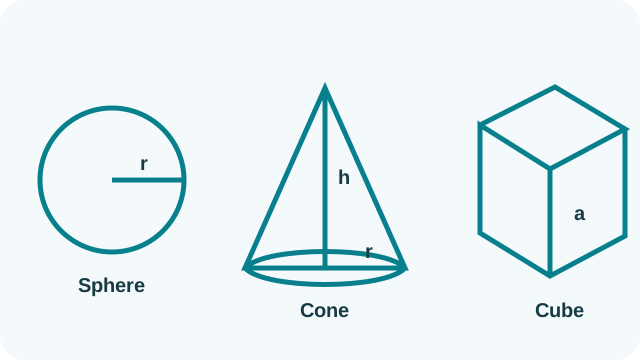
Sphere, cone, and cube with the dimensions used in their volume formulas
Use radius for the sphere, base radius and perpendicular height for the cone, or one edge for the cube.

What is Volume Calculator?

This page calculates the volume of a sphere, right circular cone or cube from linear dimensions. Every dimension is converted to metres before the selected geometric formula is applied, so the result is consistently reported in cubic metres.

Volume measures three-dimensional space. A length-unit conversion is cubed in a volume calculation: one centimetre is 0.01 metre, but one cubic centimetre is 0.000001 cubic metre. That distinction explains why a seemingly small unit mistake can produce a very large error.

How to Use This Calculator

  1. Choose the form for the solid you want to calculate.
  2. For a sphere, enter its radius and unit.
  3. For a cone, enter base radius and perpendicular height, selecting a unit for each.
  4. For a cube, enter one edge length and its unit.
  5. Select Calculate and read the result in m³.

All dimensions must be positive numbers. Radius is half the diameter, and cone height means the perpendicular distance from the base plane to the tip rather than the sloping side.

For mixed cone units, the calculator converts radius and height separately. Keep enough decimal places when measuring small objects because the final value is sensitive to every dimension.

Formula Used

Sphere: V = 4πr³/3. Cone: V = πr²h/3. Cube: V = a³.

The conversion occurs before the formula. If L metres equals the entered length, then the volume formula produces cubic metres. The page uses π from the programming language and rounds to six decimal places.

Variables Explained

Input or termMeaning
ShapeSphere, right circular cone or cube.
Radius rDistance from a centre to the surface or circular base edge.
Height hPerpendicular cone height, not slant height.
Edge aLength of any side of a cube.
Length unitThe unit attached to each entered dimension.
m³Cubic metres, the common output unit.

Worked Example

A cone has a 30 cm base radius and a 1.2 m perpendicular height. Convert 30 cm to 0.30 m, then use V = π × 0.30² × 1.2 ÷ 3.

The result is about 0.113097 m³. A reverse sense check is useful: the matching cylinder would hold three times as much, about 0.339292 m³.

Why Use This Calculator?

The calculated figure is an ideal geometric volume. Real containers may have wall thickness, rounded corners, seams, tapers or unusable space that the simple solid does not include.

For capacity planning, distinguish internal dimensions from external dimensions. External measurements overstate the space inside a tank, box or mould whenever walls have appreciable thickness.

The cube calculator applies to equal edges. A rectangular box with different length, width and height needs V = lwh and should not be forced into the cube form.

The cone equation assumes a circular base and a tip centered over the base. An oblique cone has the same formula when h is the perpendicular height, but measuring along the sloping side is still wrong.

Cubic metres can be converted to litres using 1 m³ = 1,000 L. Do that after calculating rather than treating a linear unit as though it were a volume unit.

Rounding deserves attention with tiny parts. A result below 0.0000005 m³ may display as zero at six decimal places even though the mathematical volume is positive. Use the formula or a smaller cubic unit when that precision matters.

Measurement uncertainty grows through powers. A small radius error affects a sphere through r³ and a cone through r². Do not report more reliable digits than the source measurements justify.

For material orders, volume is only one part of the estimate. Add a documented allowance for waste, compaction, voids or spillage when the project requires it rather than hiding that allowance inside a dimension.

A useful plausibility check is to compare related solids. A cone with a given circular base and height has one-third the volume of the cylinder with that same base and height. A sphere with radius r fits inside a cube of side 2r, so its volume must be less than 8r³. These comparisons catch misplaced factors without repeating the entire calculation.
Common Mistakes

  • Entering diameter in a radius field.
  • Using cone slant height instead of perpendicular height.
  • Leaving one mixed-unit dimension on the wrong scale.
  • Calling a rectangular box a cube.
  • Converting metres to centimetres without cubing the factor.
  • Treating external container volume as usable capacity.
  • Reporting six decimals from rough measurements.

Frequently Asked Questions

Does the result use my selected unit?

The input is converted to metres and the answer is reported in cubic metres.

Can I enter a diameter for a sphere?

Divide the diameter by two first because the field and formula require radius.

Can cone radius and height use different units?

Yes. Choose the correct unit beside each value; both are converted separately.

Why is a small result displayed as zero?

Six-decimal rounding can hide very small cubic-metre values. A smaller output unit may be clearer.

How do I convert cubic metres to litres?

Multiply cubic metres by 1,000.

Does this calculate cylinder volume?

No. The page currently handles a sphere, cone and cube.

Should I add a waste allowance?

Add one separately when estimating purchased material, using a percentage supported by the project conditions.

Sources & References