Serving planner

Popcorn Kernel Calculator

Estimate unpopped kernel teaspoons from guest count and the selected popped-popcorn portion.

Serving plan

Choose people and portion size

Popcorn

This uses a fixed 16:1 popping yield that differs from the Popcorn Board example. Check product yield before preparing a batch.

people
Serving summary

Kernel estimate

The kernel estimate will appear here

Portion choices are stated as cups of popped popcorn per person.

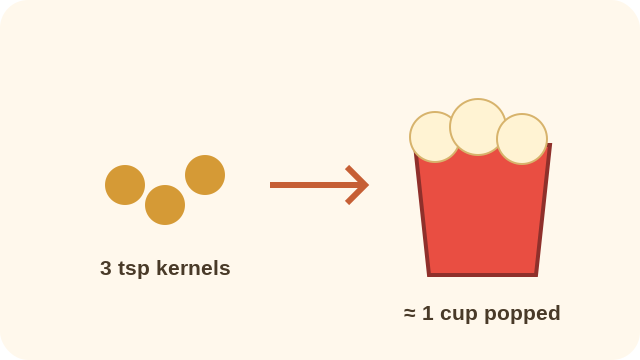
Unpopped kernels expanding into cups of popped popcorn for several people
This page assumes three teaspoons of kernels produce about one cup of popped popcorn.

How Much Popcorn Should I Plan per Person?

Estimate unpopped kernel teaspoons from people and a selected popped-popcorn portion. This calculator multiplies the two inputs to obtain planned popped cups, assumes one cup of kernels produces 16 cups popped, and converts the kernel volume to teaspoons.

The stored yield is an important limitation. The Popcorn Board’s published example implies a different expansion ratio, so the displayed amount should not be treated as an independently verified requirement for your equipment. The four portion choices are planning presets, not dietary recommendations or standardized theater container sizes.

How to Use the Popcorn Kernel Calculator

  1. Enter a positive whole Number of people. The visible four-person hint is a placeholder rather than a prefilled guest count.
  2. Choose Popped popcorn per person: 2, 8, 12 or 18 cups. The initial selection is two cups; these choices describe popped volume, not dry kernels.
  3. Select Estimate kernels. The form applies its fixed 16-cup popped yield per cup of kernels.
  4. Read unpopped teaspoons in the main result. Check planned popped cups, people and per-person cups in the smaller cards.
  5. Compare the stored yield with the kernel product and your own popping method before preparing a batch. The form has no custom yield, spare percentage or equipment setting.

People must be an integer of at least one. Only the four portion codes are accepted. There are no kernel-weight, oil, butter, flavor, calories, bag-size or price inputs. The cups refer to a volume plan rather than a claim about nutritional serving size.

Popcorn Portion and Kernel Formulas

planned popped cups = people × popped cups per person

kernel cups = planned popped cups ÷ 16

kernel teaspoons = kernel cups × 48 = planned popped cups × 3

The 48-teaspoon cup relationship is a U.S. customary kitchen volume convention, supported by the NIST unit reference. The yield divisor of 16 is a separate application assumption. The server returns kernel teaspoons to two decimals; the planned popped cups and portion cards show whole cups.

The Popcorn Board conversion chart gives 2 tablespoons of kernels yielding 1 quart, or 4 cups, popped. Converting that example gives 1.5 teaspoons per popped cup, compared with this calculator’s 3. The page therefore asks for twice the kernel volume implied by that published example. It does not explicitly calculate a loss or unpopped-kernel allowance.

Guest Count, Portions and Kernel Results

Number of people
Whole guest count of at least one. It does not infer appetite or repeat servings.
Popped popcorn per person
Selected volume of 2, 8, 12 or 18 cups per person. No custom portion field is available.
Unpopped kernels needed
Main estimate in teaspoons using the stored yield assumption. It is not popped popcorn volume.
Popped popcorn planned
People times selected portion, in cups of finished popcorn.
People reference
Guest count repeated for checking the plan.
Portion per person
The selected popped cups repeated in the result, not a dry-kernel measure.

The static image illustrates the local three-teaspoons-per-popped-cup assumption. It does not measure your kernel expansion or establish a universally correct popping yield.

Popcorn Kernel Calculation Example

Illustrative example under the stored model. Enter seven people and select eight popped cups each. Planned popped volume is 7 × 8 = 56 cups.

The local yield gives 56 ÷ 16 = 3.5 cups of kernels, then 3.5 × 48 = 168 tsp. The main answer is 168 tsp; the smaller cards show 56 popped cups, seven people and eight cups per person.

Calculation check. Independent volume arithmetic agrees with the endpoint. Choosing two cups per person instead gives 14 popped cups and 42 tsp kernels. These are outputs of the stored factor; the source comparison explains why they are not guaranteed preparation quantities.

Illustrative seven-person plans using the stored 16:1 yield
Selected portionPlan for 7 peopleLocal kernel result
8 cups each56 cups popped168 tsp kernels
2 cups each14 cups popped42 tsp kernels

Comparing the Stored and Published Popping Yields

For the original target of 56 popped cups, compare the fixed software yield with the independently published Popcorn Board example. This is a basis comparison, not a change to the calculator’s output.

Two distinct volume-yield assumptions for the same popped target
Yield basisKernels per popped cupKernel volume for 56 cups
Local model: 16 popped cups per kernel cup3 tsp168 tsp
Popcorn Board example: 32 popped cups per kernel cup1.5 tsp84 tsp

The source chart gives 2 tablespoons to 4 popped cups. Two tablespoons are 6 teaspoons, and 6 ÷ 4 = 1.5 teaspoons per popped cup. Thus 56 × 1.5 = 84 teaspoons, half the local 168-teaspoon result.

Neither the decimal precision nor a portion label resolves a yield mismatch. The form has no equipment, expansion or loss input. Check the selected product and measured popping yield instead of interpreting the stored difference as an automatically justified extra allowance.

Understanding the Popcorn Yield Assumption

The main answer is dry-kernel volume, whereas the plan cards describe popped volume. Keeping that distinction prevents a large error when filling a measure. The form does not supply kernel mass in grams or account for the different bulk packing of varieties.

The source mismatch matters more than the number of displayed decimals. The calculator uses half the popped yield per kernel cup implied by the Popcorn Board example and therefore returns double the kernels for the same popped target. Do not interpret that difference as an automatically validated safety margin.

Changing the portion preset scales every quantity linearly. A larger option is simply a larger selected plan, not a recommendation for one person to eat that much. The tool does not compare the plan with dietary guidance or calculate toppings and nutrition.

Popping performance and serving needs should be checked separately. There is no editable expansion factor, batch-capacity or spoilage field, and no reverse mode that calculates people from kernels. The additional topic compares both yield bases without silently changing this calculator’s existing formula.

Common Popcorn Planning Mistakes

  • Measuring the popped-cup result as though it were dry kernels.
  • Treating the stored expansion factor as verified for every product.
  • Assuming the source discrepancy is a calculated loss allowance.
  • Reading a portion preset as a nutritional recommendation.
  • Expecting tablespoons, grams, cooking fat or calories in the main result.
  • Adding an unspecified extra percentage and calling it a built-in calculator feature.

Popcorn Calculator FAQs

How does the popcorn calculator estimate kernels?

It multiplies people by selected popped cups per person, divides by 16 for kernel cups and multiplies by 48 for teaspoons. That is three teaspoons per planned popped cup.

Does the stored yield match the Popcorn Board chart?

No. The chart’s 2 tablespoons to 4 popped cups implies 1.5 teaspoons per popped cup. This calculator uses three, so it returns twice that example’s kernel volume.

How many kernels does the seven-person example need?

With eight popped cups per person, the local model returns 168 tsp for 56 popped cups. That is a model result; check actual yield rather than treating it as a guaranteed requirement.

Are the portion choices cups of kernels?

No. They are popped popcorn cups per person. The main answer converts the total plan to unpopped kernel teaspoons.

Can I enter a custom portion or yield?

No. The form has four portion choices and one fixed yield. It has no custom expansion factor or loss allowance.

Does it include unpopped kernels or serving waste?

No separate loss calculation appears in the code. The difference from another yield chart is not a measured allowance for your product or method.

Does this calculate oil, butter or calories?

No. The inputs only cover people and popped portion volume. Cooking fat, flavor, nutrients and package prices require separate information.

Can I use fractional people or work backward from kernels?

No. People must be a positive integer, and the visible form solves only from guest count and one of its portion presets.

Sources and References