Mathematics calculator

Power Modulo Calculator

Find the least nonnegative remainder of a large integer power without constructing the full power.

Calculator inputs

Enter your values

Modular exponentiation
Calculated output

Result summary

Your result will appear here

Complete the required fields and select the calculate button.

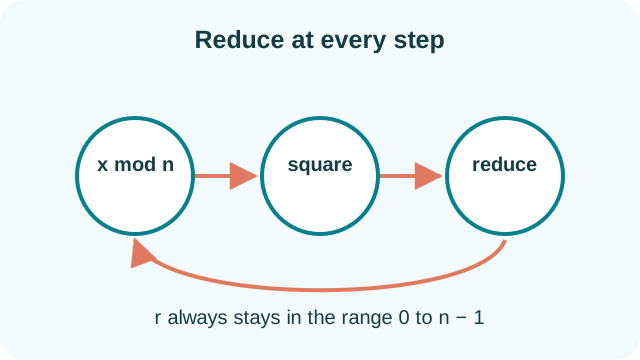
Repeated squaring steps reducing powers around a modular number cycle
Repeated squaring reduces after each multiplication, avoiding an enormous intermediate power.
1

What is Power Modulo?

The Power Modulo Calculator finds the remainder left by an integer power. Instead of first writing a number such as 37200, it repeatedly reduces smaller products by the divisor. That makes a calculation practical even when the full power would contain hundreds of digits.

Modular powers appear in number theory, repeating schedules, checksums and introductory cryptography exercises. This page accepts an integer base, a whole-number exponent from zero upward and a positive integer divisor. It reports the standard least nonnegative remainder, so the answer is always from zero through one less than the divisor.

2

How to Use This Calculator

  1. Enter the integer base. A negative base is allowed; the result is still expressed as a nonnegative remainder.
  2. Enter a nonnegative integer exponent. Zero is valid, including when the base is zero, because this calculator follows the common computational convention that a zero power contributes 1 before the modulus is taken.
  3. Enter a positive integer divisor. The page limits each input to a range that keeps repeated products within dependable whole-number arithmetic.
  4. Choose Calculate. The result panel shows the remainder, while the response also keeps the submitted values and a compact formula statement.

The calculation uses repeated squaring. It reduces the base first, squares that reduced value, and includes selected powers according to the binary digits of the exponent. Reducing after every multiplication gives the same remainder as reducing the enormous final power.

3

Formula Used

r = xy mod n, where 0 ≤ r < n and xy = qn + r for some integer q. Repeated squaring uses (ab) mod n = [(a mod n)(b mod n)] mod n.
4

Variables Explained

SymbolMeaningAccepted values
xThe integer base that will be raised to a power.−1,000,000,000 through 1,000,000,000
yThe exponent, telling how many base factors are used.Whole numbers from 0 through 1,000,000,000
nThe positive modulus or divisor used to classify the remainder.1 through 1,000,000,000
rThe least nonnegative remainder returned by the calculation.0 through n − 1

“Mod” describes a remainder relationship rather than ordinary division. Different integers are congruent modulo n when their difference is divisible by n. For example, −3 and 4 are congruent modulo 7 because they differ by 7.

5

Worked Example

Suppose x = −3, y = 5 and n = 7. First reduce the base: −3 mod 7 is 4. Repeated squaring gives 4² mod 7 = 2 and 4⁴ mod 7 = 4. Because 5 = 4 + 1, combine the required powers: (4 × 4) mod 7 = 2. A direct check gives (−3)⁵ = −243, and −243 = (−35 × 7) + 2. The calculator therefore returns 2.

This check also explains why a programming language may sometimes show −5 for a remainder from −243 and 7. Both numbers differ by 7, but this page normalizes the result to the usual range from 0 to 6.

6

Why Use This Calculator?

Read the output as a remainder class. A result of 2 means that the original power differs from 2 by an exact multiple of the divisor. It does not mean that the power equals 2, nor does it give the quotient. When the divisor is 1, the only possible remainder is 0.

For hand checking, try a smaller exponent or build a short list of repeating residues. Modular powers often repeat, although the cycle depends on the base and modulus. A zero result means the divisor divides the power exactly. It does not necessarily mean the base itself is zero.

This calculator is suitable for arithmetic study and verification. Security systems use carefully chosen large values and reviewed libraries; a small web calculation should not be used to design or assess a cryptographic system.

7

Common Mistakes

  • Entering a decimal base or exponent even though modular exponentiation here is defined on integers.
  • Using a negative exponent, which would require a modular inverse and is outside this form.
  • Entering zero as the divisor. Division by zero has no remainder.
  • Calculating the full power on an ordinary calculator first and losing precision before taking the modulus.
  • Keeping a negative programming remainder without converting it to the least nonnegative representative.
  • Reading “mod” as a percentage or as division that returns a quotient.
8

Frequently Asked Questions

Why use repeated squaring instead of calculating the full power?

The full power grows very quickly. Repeated squaring needs only a modest number of reduced multiplications, so it avoids constructing that huge integer while preserving the final remainder.

Can the base be negative?

Yes. The page first places the negative base in its equivalent remainder class. For example, −3 becomes 4 modulo 7, and the displayed answer stays between zero and six.

Why must the exponent be a whole number?

This form models repeated multiplication. Fractional powers introduce roots and may not have a single useful meaning in modular arithmetic, while negative powers require a modular inverse that may not exist.

What happens when the exponent is zero?

The calculator begins with 1, then takes that value modulo the divisor. The answer is therefore 1 for a divisor greater than 1 and 0 for a divisor of 1.

Does a zero result mean the base was zero?

No. It means the divisor divides the powered value. For instance, 6² mod 9 is 0 even though the base is 6.

Why is my software showing a negative remainder?

Some languages keep the sign of the dividend for their remainder operator. Add the positive modulus and reduce again to obtain the least nonnegative representative used here.

Can I use this page for cryptographic keys?

Use it for learning and small checks only. Real cryptographic work needs very large integers, established algorithms, secure parameter choices and independently reviewed software.

9

Sources & References