Mathematics calculator

Power of i Calculator

Reduce any supported integer power of the imaginary unit to one of the four exact cycle values.

Calculator inputs

Enter your values

Complex-number cycle
Calculated output

Result summary

Your result will appear here

Complete the required fields and select the calculate button.

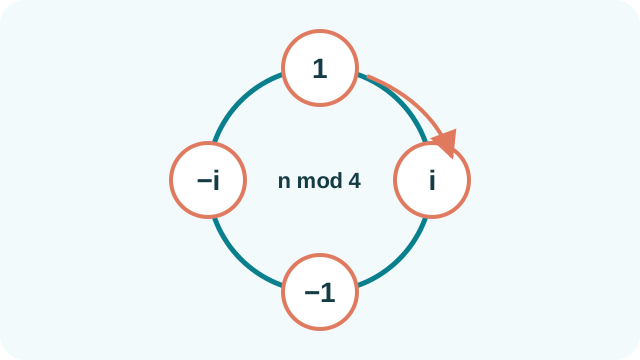
Four-step cycle from one to i to negative one to negative i and back to one
The powers repeat every four exponents because i⁴ = 1.

What is Power of i?

The Power of i Calculator simplifies an integer power of the imaginary unit. The imaginary unit i is defined by i² = −1. Its powers repeat in a four-step pattern, so even a very large positive or negative exponent reduces to one of four exact answers: 1, i, −1 or −i.

This is useful when simplifying complex-number expressions by hand, checking an algebra exercise or spotting a sign error. The input must be an integer because the four-value cycle applies directly to integer powers. No decimal rounding is involved in the result.

How to Use This Calculator

  1. Enter an integer exponent n. Both positive and negative integers are supported within the displayed numeric limit.
  2. Choose Calculate. The page finds the exponent’s least nonnegative remainder after division by 4.
  3. Match remainder 0 with 1, remainder 1 with i, remainder 2 with −1, or remainder 3 with −i.
  4. Read the displayed equality. For a negative exponent, the same cycle works because i is nonzero and its reciprocal is −i.

The shortcut comes from i⁴ = 1. Multiplying any power by i⁴ leaves its value unchanged, so exponents that differ by a multiple of four have the same result. The calculator normalizes negative remainders before selecting the matching value.

Formula Used

i² = −1 and i⁴ = 1. If r = n mod 4 with r in {0,1,2,3}, then iⁿ equals 1, i, −1 or −i respectively.

Variables Explained

ItemMeaningExample
iThe imaginary unit, defined as a number whose square is −1.i² = −1
nThe integer exponent entered in the form.−9
rThe remainder of n modulo 4, normalized to 0, 1, 2 or 3.−9 mod 4 = 3
iⁿThe simplified exact value of the power.i⁻⁹ = −i

Complex numbers have a real part and an imaginary part. In these four answers, 1 and −1 lie on the real axis, while i and −i lie on the imaginary axis. The result is exact, so a decimal approximation would add no useful information.

Worked Example

Find i−9. Dividing −9 by 4 gives a normalized remainder of 3, because −9 = (−3 × 4) + 3. The remainder-3 position in the cycle is −i, so the calculator displays i−9 = −i.

You can confirm it using reciprocals. Since i⁹ = i, then i⁻⁹ = 1/i. Multiply numerator and denominator by i: i/i² = i/(−1) = −i. Both approaches give the same exact result.

Why Use This Calculator?

The output is the fully simplified value of that single power. If it is i or −i, its real part is zero. If it is 1 or −1, its imaginary part is zero. The exponent itself may be large, but only its position in the four-step cycle affects the answer.

When this power appears inside a longer expression, substitute the returned value and then combine like real and imaginary terms. Keep parentheses around a negative result. For example, 3 + 2i⁶ becomes 3 + 2(−1), which simplifies to 1.

The page does not evaluate a general complex power such as (2 + 3i)⁵, a fractional power of i, or an expression containing several operations. Those problems require the relevant complex-number rules and, for noninteger powers, attention to multiple possible values.

A quick reasonableness check is to add or subtract four from the exponent. The answer should stay exactly the same. Moving forward by one exponent should multiply the current result by i and move to the next position in the cycle.

Common Mistakes

  • Assuming i is an ordinary variable rather than the number defined by i² = −1.
  • Using only a two-step sign pattern and forgetting that i and −i alternate with the real values.
  • Treating a negative exponent as a negative copy of the positive power instead of a reciprocal.
  • Using a negative remainder directly instead of normalizing it to 0, 1, 2 or 3.
  • Typing a decimal exponent; this page accepts integers only.
  • Dropping parentheses when substituting −1 or −i into a larger expression.

Frequently Asked Questions

Why do powers of i repeat every four exponents?

Because i⁴ = 1. Multiplying a value by another factor of i⁴ changes the exponent by four but multiplies the result by 1, leaving it unchanged.

What is i to the power zero?

It is 1. This follows the usual zero-exponent rule for every nonzero number, and i is nonzero.

How does the calculator handle a negative exponent?

It normalizes the exponent modulo four. This agrees with the reciprocal rule; for example, i⁻¹ = 1/i = −i.

Is the answer an approximation?

No. Each possible output is an exact complex number. There is no rounding step.

Can I enter a fraction such as one half?

No. Complex roots can have more than one value, so a fractional exponent needs conventions beyond this four-position integer cycle.

How can I check the sign by hand?

Write the short cycle 1, i, −1, −i under remainders 0, 1, 2 and 3. Divide the exponent by four and use its normalized remainder.

Does this simplify an entire complex expression?

It simplifies one power of i. Substitute that result into the larger expression, then separately combine its real terms and its imaginary terms.

Sources & References