ISO metric thread geometry

Thread Calculator

Estimate basic pitch and minor diameters for an external or internal metric thread.

Thread details

Select the thread profile

Metric
Basic dimensions

Thread result

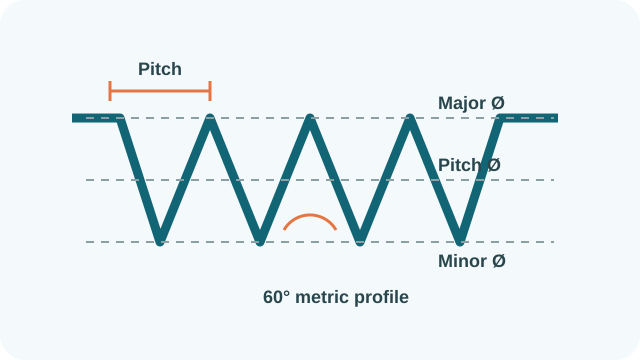
Metric V-thread profile showing major, pitch, and minor diameters and thread pitch
The basic diameters describe the ideal 60-degree metric thread profile before tolerance allowances.

Your thread dimensions will appear here

Select the profile and pitch, then enter the major diameter.

1

What is Thread Calculator?

This thread calculator estimates the basic pitch diameter and basic minor diameter for a 60-degree metric-style thread profile from a basic major diameter and pitch. Choose external for a screw or bolt profile, or internal for a nut or tapped-hole profile. Diameter may be entered in centimetres, millimetres, inches or micrometres; pitch is selected in millimetres.

The outputs are theoretical basic dimensions in millimetres. They are not manufacturing limits. Real metric threads require a designation, tolerance class, allowances, crest and root form, inspection method and often a specified engagement length.

2

How to Use This Calculator

  1. Choose external or internal thread dimensions.
  2. Select the pitch in millimetres. Check the selected pitch against the intended standard designation.
  3. Enter the basic major diameter and choose its unit.
  4. Select Calculate.
  5. Use the outputs as basic-profile references, then consult the applicable standard for permitted limits.

The major diameter is converted to millimetres before the formulas are applied. A combination that would produce a zero or negative minor diameter is rejected. The list includes common pitch values but does not confirm that every diameter-pitch combination is a preferred standard size.

3

Formula Used

For this 60-degree basic profile, basic pitch diameter = D − 0.64952P. For an external thread, basic minor diameter = D − 1.22687P. For an internal thread, basic minor diameter = D − 1.08253P, where D and P are in millimetres.

The external and internal pitch diameters share the same basic value, while their basic minor diameters differ because the profile truncations differ. These equations do not add tolerance or allowance and do not predict a measured pitch diameter under a particular inspection method.

4

Variables Explained

Symbol or choiceMeaning
DBasic major diameter after conversion to millimetres.
PAxial distance between adjacent thread forms, in millimetres.
Pitch diameterDiameter of the ideal cylinder where thread ridge and groove widths are equal.
Minor diameterDiameter at the roots of an external or internal basic profile.
ExternalScrew or bolt basic profile.
InternalNut or tapped-hole basic profile.
5

Worked Example

Choose an external thread, pitch 1.5 mm and major diameter 10 mm. Pitch diameter is 10 − (0.64952 × 1.5) = 9.02572 mm, displayed as 9.0257 mm.

External minor diameter is 10 − (1.22687 × 1.5) = 8.159695 mm, displayed as 8.1597 mm. For an internal basic profile with the same D and P, the pitch diameter remains 9.0257 mm while the minor diameter would be 8.3762 mm. Neither pair includes tolerance limits.

6

Why Use This Calculator?

The numbers describe geometry of an ideal basic profile. A machinist cannot use them alone as maximum and minimum acceptance sizes. Metric thread designations such as M10 × 1.5 also need a tolerance class, and actual crest or root geometry may be rounded or truncated according to the standard.

Pitch must match the diameter and thread series. A 0.4 mm selection previously mislabeled on this page has been corrected, but users should still verify a preferred combination in current tables. If the input is inches, only the diameter is converted; the selected pitch remains metric. That makes the page unsuitable for directly modeling Unified threads specified in threads per inch without first choosing an equivalent metric pitch and confirming the profile assumptions.

For production, use calibrated gauges or specified measurement methods and the governing standard.

The major diameter and pitch also influence thread depth as a proportion, but they do not describe how far mating parts engage. Strength checks depend on material, engagement length, shear area, loading and manufacturing condition. Plated or coated threads may require allowance for coating thickness. Tapped-hole drill selection is another separate task: a calculated basic minor diameter is not automatically the recommended drill size, because cutting behavior, material and desired thread percentage matter.

7

Common Mistakes

  • Entering threads per inch in the millimetre pitch selector.
  • Mixing the major-diameter unit with an assumed pitch unit.
  • Using an internal minor formula for an external thread.
  • Treating basic dimensions as tolerance limits.
  • Assuming every listed pitch is standard for every diameter.
  • Ignoring tolerance class, allowance and engagement length.
  • Using the result as a substitute for inspection.
8

Frequently Asked Questions

Is thread pitch entered in millimetres?

Yes. Every listed pitch is in millimetres regardless of the major-diameter unit.

Does the result include tolerance?

No. It gives theoretical basic dimensions only.

Why do internal and external minor diameters differ?

Their basic root and crest truncations differ even though the pitch diameter is shared.

Can I calculate an inch Unified thread directly?

The diameter can be converted from inches, but the formulas and pitch selector are framed as a metric 60-degree basic-profile reference.

What is pitch diameter?

It is the diameter of an ideal cylinder where thread ridge width equals groove width.

Does every pitch fit every diameter?

No. Verify the intended standard series and designation.

Can these values replace a thread gauge?

No. Production acceptance requires specified tolerances and suitable measurement or gauges.

9

Sources & References