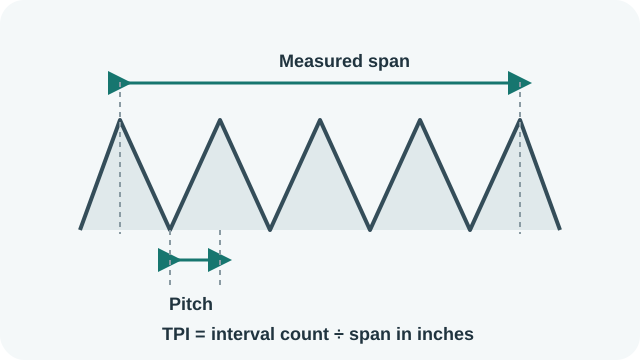
The thread pitch calculator works from a measured threaded length and the number of thread intervals across that length. It reports threads per inch (TPI) and the corresponding axial pitch in inches. This is useful when checking an unknown inch-series fastener, comparing a physical measurement with a specification, or understanding the reciprocal relationship between TPI and pitch. It does not identify thread diameter, thread form, class of fit, handedness, or whether a part conforms to a particular standard. Those details must also match before two threaded parts are considered compatible.
Thread Pitch Calculator
Find threads per inch and axial pitch from a measured thread span and interval count.
Thread details
TPIEnter span and intervals
Thread summary
Your result
Your thread pitch will appear here
Enter the measured span and number of intervals, then calculate TPI and pitch.
Threads per inchThread intervals ÷ measured length in inches
- Pitch in inches
- 0 in
- Pitch in millimetres
- 0 mm
- Intervals counted
- 0
Pitch alone does not identify thread diameter, form, fit class, or handedness.
Table of Contents
1
What is Thread Pitch?
2
How to Use This Calculator
- Measure a useful threaded length along the fastener axis. A longer span usually reduces the effect of a small reading error.
- Count the thread intervals within that same span. Count repeated spacing carefully: the number of visible crests and the number of intervals between them are not always identical.
- Enter the length and select millimetres, centimetres, metres, or inches. The calculation converts it to inches.
- Enter the thread count as a positive value and choose Calculate.
- Compare the TPI and pitch with an applicable fastener specification or a thread gauge.
Keep the measurement parallel to the fastener axis. Measuring along the sloping flank or around the helix gives a longer path and an incorrect pitch.
3
Formula Used
Length in inches is found with the selected conversion: millimetres ÷ 25.4, centimetres ÷ 2.54, metres × 39.3701, or inches unchanged.
TPI = counted thread intervals ÷ measured length in inches
Pitch in inches = 1 ÷ TPI
Pitch and TPI express the same spacing in reciprocal forms. A larger TPI means the threads are closer together and therefore have a smaller pitch. For a metric comparison, multiply the displayed inch pitch by 25.4 to obtain millimetres per thread.
4
Variables Explained
| Value | Meaning |
|---|---|
| Threaded length | Axial distance over which the intervals were counted. |
| Thread count | Number of equal thread intervals represented by the measured span. |
| TPI | Threads per inch, calculated after converting the measured length to inches. |
| Pitch | Axial distance from one corresponding thread point to the next, reported in inches. |
| 25.4 | Exact number of millimetres in one international inch. |
| Thread form | Profile and angle of the thread; it is not determined by this calculation. |
5
Worked Example
Suppose 40 thread intervals are counted across exactly 2 inches. TPI is 40 ÷ 2 = 20 TPI. Pitch is the reciprocal: 1 ÷ 20 = 0.050 inch. In metric terms, 0.050 × 25.4 = 1.27 mm. Entering the same measured span as 50.8 mm gives the same result because 50.8 mm equals 2 inches. The answer describes spacing only; it does not by itself establish that the fastener is a particular nominal size.
6
Why Use This Calculator?
A result close to a recognized TPI value can help narrow down a thread, but “close” is not enough for assembly or safety-critical selection. Measurement error, damage, coatings, dirt, and counting the wrong endpoints can shift the calculated value. Check the nominal diameter with a suitable measuring tool and check pitch with a gauge where possible. Metric thread designations ordinarily state pitch in millimetres rather than TPI.
Multi-start threads need extra care. Their lead, the distance advanced in one full turn, equals pitch multiplied by the number of starts. This page reports spacing derived from the observed thread count and does not detect the number of starts. Consult the manufacturer or an applicable engineering standard for pressure systems, lifting equipment, vehicles, aerospace hardware, or any connection whose failure could cause harm.
7
Common Mistakes
- Counting crests without deciding which intervals the measured endpoints cover can create an off-by-one error.
- Measuring only one tiny interval magnifies ruler and alignment error; use several intervals where practical.
- Selecting millimetres after entering inches changes the converted length by a factor of 25.4.
- Confusing pitch with lead gives a wrong movement-per-turn value on multi-start threads.
- Assuming matching TPI guarantees fit ignores diameter, form, class, taper, and handedness.
- Rounding a near match to a preferred value without checking a gauge may misidentify worn or damaged threads.
8
Frequently Asked Questions
Is pitch the same as threads per inch?
They describe the same spacing in opposite ways for inch units. Pitch in inches is 1 divided by TPI, while TPI is 1 divided by pitch in inches.
Should I count peaks or spaces?
Count consistent thread intervals across the measured axial length. If measuring from one crest center to another, count the spaces between those crest centers.
Can I identify a metric thread with this result?
You can convert the inch pitch to millimetres by multiplying by 25.4, then compare it with a metric specification. Diameter and thread form must also match.
Why should I measure several threads?
A small ruler error becomes a smaller fraction of the total when spread across several intervals. Divide the total interval count by the full measured length.
What is the difference between pitch and lead?
Pitch is spacing between adjacent threads. Lead is axial travel in one turn; on a single-start thread they match, while on a multi-start thread lead is larger.
Does a matching TPI prove a nut will fit?
No. Nominal diameter, profile, tolerance class, taper, handedness, damage, and material condition also affect fit.
Can the thread count include a decimal?
A measured partial interval can be represented numerically, but an exact count across clear endpoints is easier to verify. Avoid false precision from an uncertain visual fraction.
9
Sources & References
NASA’s Fastener Design Manual discusses thread terminology, including pitch, lead, and threads per inch. A NASA Kennedy Space Center fastener standard shows practical tables relating metric pitch and TPI. Exact inch and metric conversion relationships are documented in the NIST Guide to SI conversion factors.