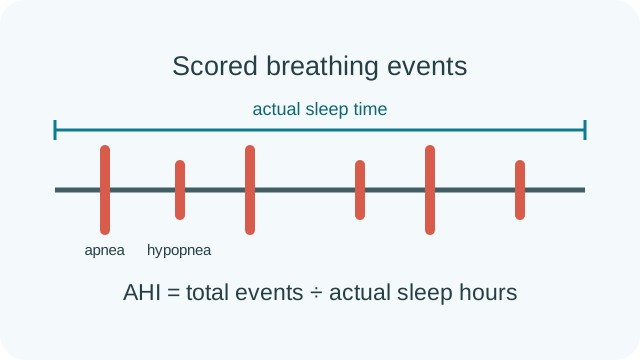
Calculate scored apnea and hypopnea events per hour of actual sleep.
Sleep-study values
Enter events and sleep duration
AHI
Event-rate summary
Calculated index
The AHI will appear here
Use event counts and actual sleep time from the same sleep assessment.
Apnea-hypopnea index(apneas + hypopneas) ÷ actual sleep hours
AHI
0 events/hour
Total scored events
0
Actual sleep time
0 hours
Reference band
—
Educational estimate only. It is not medical advice, a diagnosis, or a substitute for assessment by a qualified healthcare professional. This page cannot detect breathing events or determine a diagnosis from symptoms.
AHI is a rate: the total scored events are divided by actual sleep time, not simply time in bed.
What is Apnea Hypopnea Index?
The Apnea-Hypopnea Index (AHI) Calculator estimates the number of breathing interruptions that occur per hour of sleep. It uses the total number of apnea and hypopnea episodes and the actual time spent sleeping to calculate the AHI value.
AHI is commonly used in sleep medicine to help assess the frequency of breathing disturbances associated with sleep-disordered breathing, including obstructive sleep apnea. The result can help you understand sleep study findings, but a healthcare professional must interpret it alongside symptoms and other clinical information.
How to Use This Calculator
The AHI Calculator requires three main inputs:
Apnea Episodes: The total number of apnea events recorded during sleep.
Hypopnea Episodes: The total number of hypopnea events recorded during sleep.
Actual Sleep Time: The amount of time you actually spent sleeping, entered in hours, minutes, or seconds.
The calculator converts the actual sleep time into hours, adds the apnea and hypopnea episodes, and divides the total number of events by the number of hours slept.
The final result is the Apnea-Hypopnea Index (AHI), measured in events per hour of sleep.
Formula Used
The calculator uses the following formula:
AHI = (Apnea Episodes + Hypopnea Episodes) / Total Sleep Time in Hours
Where:
AHI: Apnea-Hypopnea Index.
Apnea Episodes: Total recorded apnea events.
Hypopnea Episodes: Total recorded hypopnea events.
Total Sleep Time: Actual sleep duration expressed in hours.
Important: Actual sleep time must be greater than zero. The calculation should use sleep study measurements when available rather than simply the time spent in bed.
Variables Explained
Apnea Episodes: Apnea refers to a temporary interruption of airflow during sleep. The number entered should come from a sleep study or an appropriate clinical assessment.
Hypopnea Episodes: Hypopnea refers to a reduction in breathing airflow during sleep that meets the applicable clinical scoring criteria. The recorded number depends on the criteria used by the sleep laboratory.
Actual Sleep Time: The total time spent asleep during the assessment. It may be recorded in hours, minutes, or seconds. The calculator converts this value into hours before calculating AHI.
AHI Result: The number of apnea and hypopnea events per hour of sleep. A higher AHI generally indicates more frequent breathing disturbances during sleep.
Worked Example
Suppose a sleep study records the following results:
Apnea Episodes: 20
Hypopnea Episodes: 40
Actual Sleep Time: 6 hours
Step 1: Add the breathing events.
Total Events = 20 + 40 = 60 events
Step 2: Convert sleep time into hours.
Total Sleep Time = 6 hours
Step 3: Apply the AHI formula.
AHI = 60 / 6
AHI = 10 events per hour
Why Use This Calculator?
For adults, AHI results are commonly grouped into the following categories:
AHI below 5 events/hour: Within the normal range under commonly used adult criteria.
AHI from 5 to less than 15 events/hour: Mild sleep apnea range.
AHI from 15 to less than 30 events/hour: Moderate sleep apnea range.
AHI of 30 events/hour or higher: Severe sleep apnea range.
These categories are commonly used when assessing obstructive sleep apnea in adults. An AHI below 5 does not necessarily rule out every sleep disorder, and the result alone cannot establish a diagnosis.
Important: AHI thresholds and interpretation may differ for children and in particular clinical circumstances. Consult a qualified healthcare professional for an accurate assessment and appropriate treatment recommendations.
Common Mistakes
1. Entering time in the wrong unit
Make sure you select the correct unit for actual sleep time. For example, enter 6 with hours selected for six hours of sleep, or 360 with minutes selected.
2. Using time spent in bed instead of actual sleep time
AHI is calculated using actual sleep time when that measurement is available. Time spent awake in bed should not automatically be counted as sleep.
3. Forgetting to add both types of events
The formula includes both apnea and hypopnea episodes. Omitting either count may produce an incorrect AHI value.
4. Entering incorrect episode counts
Use the apnea and hypopnea counts recorded in the sleep study. Estimates that are not based on appropriate measurements may not provide a reliable result.
5. Treating the result as a diagnosis
An AHI value is one part of a sleep assessment. Symptoms, oxygen levels, medical history, and other findings may also be important for diagnosis and treatment.
6. Entering zero sleep time
The total sleep time must be greater than zero because division by zero is mathematically undefined. The calculator should not produce an AHI result when sleep duration is zero.
Frequently Asked Questions
<h3>What is the Apnea-Hypopnea Index (AHI)?</h3>
The Apnea-Hypopnea Index (AHI) is the average number of apnea and hypopnea events per hour of sleep. It is commonly used to help assess the frequency of breathing disturbances during sleep.
<h3>How is AHI calculated?</h3>
AHI is calculated by adding the total apnea and hypopnea episodes and dividing the result by the actual sleep time in hours.
AHI = (Apnea Episodes + Hypopnea Episodes) / Sleep Time in Hours
<h3>What is a normal AHI?</h3>
For adults, an AHI below 5 events per hour is generally considered within the normal range under commonly used criteria. However, results should be interpreted alongside symptoms and other clinical findings.
<h3>What does an AHI of 10 mean?</h3>
An AHI of 10 events per hour falls within the commonly used mild sleep apnea range for adults. A healthcare professional should assess the result in the context of the person's symptoms and sleep study findings.
<h3>What is considered severe sleep apnea?</h3>
For adults, an AHI of 30 or more events per hour is commonly categorized as the severe range. A diagnosis and treatment plan should be determined by a qualified healthcare professional.
<h3>Can I calculate AHI using minutes instead of hours?</h3>
Yes. This calculator accepts sleep duration in hours, minutes, or seconds and converts it into hours before performing the calculation. Select the correct unit to obtain a meaningful result.
<h3>What is the difference between apnea and hypopnea?</h3>
Apnea involves a temporary cessation of airflow, while hypopnea involves a reduction in airflow that meets defined clinical scoring criteria. Both types of events may contribute to the AHI.
<h3>Can a normal AHI rule out all sleep disorders?</h3>
No. An AHI below 5 does not rule out every sleep disorder or explain every sleep-related symptom. Further evaluation may be appropriate when symptoms persist.
<h3>Can this calculator diagnose sleep apnea?</h3>
No. This calculator performs a mathematical calculation using the event counts and sleep duration entered. It cannot diagnose sleep apnea or replace a professional sleep assessment.
<h3>Is AHI interpreted differently in children?</h3>
Yes. Children require age-appropriate clinical interpretation, and adult AHI categories should not automatically be applied to them. Consult a pediatric sleep specialist or qualified healthcare professional for interpretation.
Sources & References
American Academy of Sleep Medicine (AASM): Clinical guidance and scoring resources for sleep-related breathing events. AASM Clinical Resources.
National Heart, Lung, and Blood Institute (NHLBI): Information about sleep apnea, symptoms, diagnosis, and treatment. NHLBI Sleep Apnea.