Work out a miter arrangement from the joint angle and board widths.
Miter Angle Calculator
Form
Results
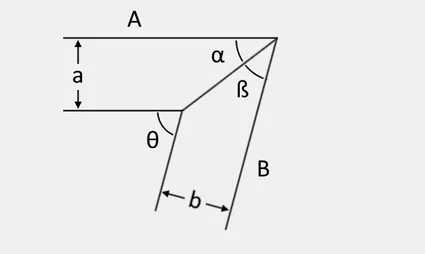
Miter angles α and ß
0
Table of Contents
1
What is Miter Angle?
2
How to Use This Calculator
- Enter or select Joint angle (θ), Width of board A, Width of board B.
- Check the unit beside each measurement. For a percentage or rate, use the scale and time period stated in the form.
- Choose Calculate, then compare the output with the formula and example below. If you change a value or option, calculate again to update the result.
3
Formula Used
For equal-width boards in a symmetric joint, each miter takes half the joint angle.
4
Variables Explained
| Input | What it means |
|---|---|
| Joint angle (θ) | The angle for the selected function, in degrees or radians as stated beside the input. |
| Width of board A | The crosswise measurement, perpendicular to the length. |
| Width of board B | The crosswise measurement, perpendicular to the length. |
5
Worked Example
A symmetric 90° corner uses two 45° cuts.
6
Why Use This Calculator?
Use the result to put measurements on a common basis before comparing them or estimating quantities. The original measurement precision still limits the precision of the answer.
7
Common Mistakes
- Unequal board widths need unequal cuts; the simple half-angle rule no longer describes the whole joint.
8
Frequently Asked Questions
When should I round a measurement?
Carry the measured values and conversion factors through the calculation first. Round the final result to a precision justified by the original measurements.
Why can a supplier’s quantity differ?
Measurement conventions, nominal sizes, density assumptions and purchase rounding can change a practical quantity. Compare the units and assumptions before comparing the numbers.
9
Sources & References

Mini Calculator provides online calculators for multiple niches including mathematical, financial, Health, informative, Chemistry, physics, statistics, and conversions. You can use any calculator for free without any limits.