This paver sand calculator estimates the compacted bedding quantity for a rectangular paved area. It converts the entered dimensions to metres, finds area and volume, adds a default 10% allowance, then uses your bulk density to estimate tonnes, 50 kg bags, and cost. It is useful for a patio, path, or small driveway estimate when the sand bed has a reasonably even depth. Site conditions and the paving manufacturer’s specification still decide what should actually be ordered.
Paver Sand Calculator
Estimate bedding-sand volume, weight, 50 kg bags, and cost with an adjustable waste allowance.
Paved area and sand
PaversEnter bedding details
Purchase summary
Sand estimate
Your sand estimate will appear here
Enter paved dimensions, bedding depth, density, waste, and price.
Sand including wasteAdjusted volume × density
- Base volume
- 0 m³
- Volume with waste
- 0 m³
- 50 kg bags
- 0
- Estimated cost
- 0
Confirm whether the project needs bedding sand, jointing sand, or both; they are separate quantities.
What is Paver Sand?
How to Use This Calculator
- Measure the finished area’s length and width. Break an L-shaped or irregular project into rectangles and calculate them separately.
- Enter the planned bedding depth. The form accepts centimetres, millimetres, or inches for depth and converts that measurement to metres.
- Enter the sand’s loose or compacted bulk density in kilograms per cubic metre. Use the value from the supplier for the product you intend to buy.
- Enter the quoted price per metric tonne and select its currency. Choose Calculate to see base volume, volume with the default allowance, estimated weight, bag count, and cost.
The page adds 10% to the geometric volume before it calculates weight and cost. That allowance can help with small level variations and handling loss, but it is not a universal purchasing rule. A carefully prepared rectangular bed may need less; uneven ground, cuts, spillage, and uncertain measurements may justify more.
Formula Used
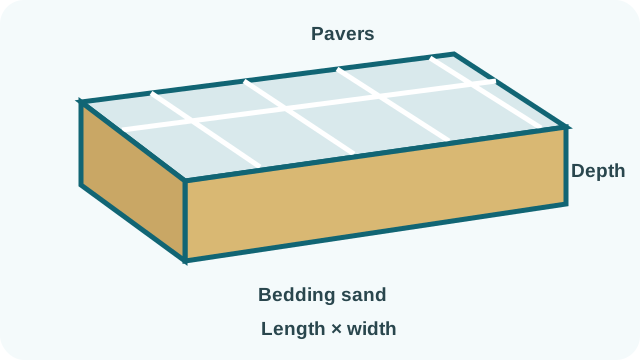
Area = length × width. Base volume = area × depth. Allowed volume = base volume × 1.10. Weight (kg) = allowed volume × density. Tonnes = weight ÷ 1,000. Cost = tonnes × price per tonne.
The bag figure rounds weight upward to the next whole 50 kg bag. All dimensions are converted to metres before multiplication. The result assumes one uniform layer and does not subtract pavers, edge restraints, drains, or other objects within the measured rectangle.
Variables Explained
| Input or result | Meaning |
|---|---|
| Length and width | Finished plan dimensions of the section, converted to metres. |
| Depth | Average compacted bedding thickness, converted to metres. |
| Density | Sand mass per cubic metre; product moisture and compaction can change it. |
| Price | Supplier price for one metric tonne in the selected currency. |
| Allowance | An extra 10% added by the current calculator. |
| Bags | Estimated whole 50 kg bags, always rounded upward. |
Worked Example
For a 5 m by 4 m patio with a 5 cm sand bed, the area is 20 m² and the base volume is 20 × 0.05 = 1.00 m³. Adding 10% gives 1.10 m³. With a supplier density of 1,600 kg/m³, the estimated purchase weight is 1,760 kg, or 1.76 tonnes. That equals 35.2 nominal 50 kg bags, so the page rounds up to 36 bags. At $50 per tonne, the estimated material cost is $88.00.
Why Use This Calculator?
Use base volume to check the geometry and allowed volume to plan the order. Weight and cost are only as reliable as the density and price. Ask whether the supplier sells by loose tonne, bulk bag, or nominal small bag, and confirm whether delivery, tax, deposit, or minimum-order charges are separate. A bag’s marketed weight may also differ from the calculator’s fixed 50 kg assumption.
Bedding sand is only one part of a paving build-up. The required excavated depth, aggregate base, bedding thickness, jointing material, drainage fall, and edge restraint depend on soil, load, climate, and the selected paver system. Follow local construction requirements and the product instructions for those choices.
Common Mistakes
- Entering centimetres while leaving the selector on metres, or measuring depth before compaction but using a compacted target.
- Using a generic density when the supplier publishes a product-specific bulk density.
- Assuming the displayed cost includes delivery, tax, pallet fees, or a minimum order.
- Using overall garden dimensions rather than the paved footprint.
- Adding another 10% without noticing that this page already includes its own allowance.
- Assuming the 50 kg bag count matches every retailer’s package size.
Frequently Asked Questions
Does the result include a waste allowance?
Yes. The current calculation adds 10% to the base geometric volume before estimating weight, bags, and cost. Do not add it a second time unless you deliberately want a larger reserve.
What density should I enter?
Use the bulk-density figure supplied for the exact bedding sand, ideally in the condition in which it will be delivered. Moisture, grading, and compaction can change mass per cubic metre.
Is the price entered per bag or per tonne?
Enter a price per metric tonne. If the quote is per bag, calculate the bag purchase separately using the supplier’s actual bag weight and price.
Why is the bag count rounded up?
You cannot normally buy a fraction of a sealed bag. The page divides estimated kilograms by 50 and raises any fraction to the next whole bag.
Can I calculate an irregular patio?
Split the plan into simple rectangles, calculate each section, and add their quantities. Treat curved edges and cut-heavy patterns with a suitable additional allowance.
Does this calculate the aggregate base too?
No. The result covers the entered sand layer only. Aggregate base, joint sand, pavers, edging, and excavation require separate quantities.
How accurate should my measurements be?
Measure each section in several places when edges or levels vary. Keep full values during arithmetic and round the purchase quantity only after checking supplier packaging and minimums.